Product FAQ
What Happens When a Diesel Generator Runs at Low Load?
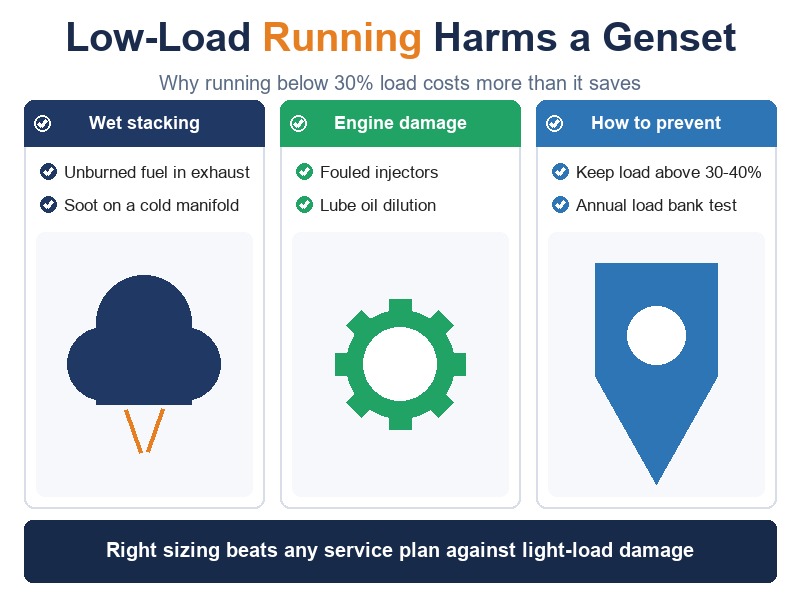
A diesel generator that runs far below its rated capacity can look like a safe, conservative choice. In practice, light loading is one of the most common causes of premature engine wear on standby generator sets, and the symptoms often appear months after installation, when the warranty conversation is already difficult.
Why light load is hard on a diesel engine
Diesel engines are designed to reach working temperature under load. When a set runs below roughly 30 percent of its rating for long periods, combustion temperature drops and the fuel charge no longer burns completely. Unburned fuel and soot accumulate in the exhaust path, a condition usually called wet stacking or slobbering. Because the exhaust manifold stays relatively cool, these deposits do not burn off the way they would during a proper loaded run. The same incomplete combustion leaves carbon on injector tips and around valve seats.
How the problem shows up
The early signs are easy to miss. Operators often notice black smoke at start-up, unusually dark lube oil, soot around the exhaust outlet, or a persistent smell of unburned fuel. Fuel consumption per kWh creeps upward as efficiency falls. Left unchecked, the deposits restrict the exhaust path and foul the injectors, while unburned fuel finds its way past the piston rings and dilutes the lube oil. In advanced cases the cylinder walls become too smooth to hold an oil film, a condition known as bore polishing, and the engine starts burning oil as well as fuel.
Keeping load in a healthy range
The practical target for most standby diesel generator sets is to keep sustained load above 30 to 40 percent of the rating. Where the real demand is genuinely small, the right answer is a smaller set rather than a large one running light. Where demand varies widely, a periodic load bank test at 70 to 80 percent of rating for an hour or two will burn off accumulated deposits and prove the set can still carry its rated load when the mains fail. Sites that treat the load bank test as an annual routine typically see far fewer injector and exhaust problems.
What this means when specifying a set
Oversizing is not the safe option it appears to be. The useful figure is not the total connected load but the load the site will actually carry for most of the year, with a sensible allowance for growth. For a facility whose normal demand sits at 200 kW, a 250 kW set working steadily is a healthier installation than a 500 kW set idling at 40 percent of rating half the time. Yunnan Zhenbang (ZIMBON) supplies diesel generator sets from 5 kW to 2500 kW with Yuchai, Cummins, Mitsubishi and Volvo power, and can help match capacity to the measured load profile rather than the nameplate total.
Categories
News
Contact Us
Contact: yuchai Generator Set
Phone: +86 13312561188
Tel: +86-0871-67352758
E-mail: postmaster@zimbon.com
Add: 11th Floor, Office Building C, Shuangcheng Intercity Business Center, No. 8868 Guangfu Road, Guandu District, Kunming City, Yunnan Province, China