Product FAQ
Diesel Just Got Cheaper: How Many Hours Should a 500 kW Genset Store?

China's latest retail fuel price window opens at midnight on 26 November. Market monitors expect diesel to drop by RMB 420–520 per tonne, roughly RMB 0.35 per litre for grade 0 at the pump. It is the second cut this month, after a RMB 625 per tonne reduction on 12 November. The question we keep receiving is simple: with diesel cheaper, should a standby generator store more fuel?
Short answer: size the tank by hours of full load, not by days. The discount lasts one night; diesel lasts three to six months.
1. Hours first, litres second
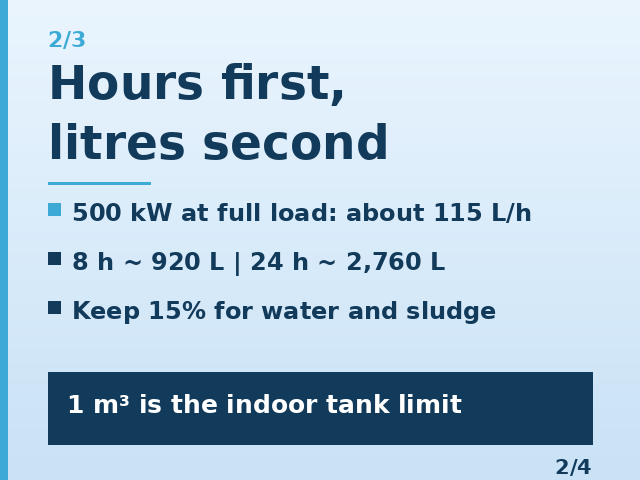
The calculation is one line: litres per hour = rated power (kW) × specific fuel consumption (g/kWh) ÷ 1000 ÷ density 0.84. At 200 g/kWh, a 500 kW genset burns about 115 litres per hour at full load; catalogue values usually sit between 105 and 120 L/h.
Then multiply by the hours the site must ride through. A standby set sized for 8 hours needs roughly 880–920 litres at 500 kW. Critical loads such as data centres or fire pumps sized for 24 hours need 2,600–2,760 litres. Add 15% for sludge space and drain volume; a tank should never be planned to its theoretical maximum.
Two limits matter. Inside a civil building, the fuel storage room may hold no more than 1 cubic metre in total; anything above that goes to an outdoor tank farm with a fire dike, and 1 m³ is only about eight hours for a 500 kW set. In practice most machine rooms run a small indoor day tank plus an outdoor tank covering 24 to 72 hours.
Conclusion: decide the ride-through hours, multiply by consumption, and only then look at the price. Reverse the order and you buy a tank that is too large while the fuel inside goes stale.
2. The money you save can be eaten by storage
Run the numbers: 2,760 litres for 24 hours at 500 kW, times RMB 0.35, saves about RMB 966. That is real money, but diesel is not wine — it does not improve with age.
Automotive diesel oxidises and forms gum after three to six months. Microbes grow at the oil-water interface, clogging filters first and injectors next. Water accumulation at the tank bottom is normal and faster in the rainy season; once water reaches the high-pressure pump, repairs start in four figures. Fixed machine rooms should top up on a rolling 8-hour day tank plus 24-hour reserve; sites should refill every 7 to 15 days rather than stock three months at once.
Three routines: drain water from the tank bottom every quarter until clean diesel appears; test appearance, water content and particulates every three months; add an antioxidant stabiliser for long storage and fit a dryer on the breather. When you count the cost of replacing fuel, cleaning the tank and changing filters, bulk buying rarely pays.
Conclusion: a price cut changes the cost of this one tank, not how long the fuel keeps. Refill by consumption, not by price.
3. Change the grade before chasing the discount
Grade 0 diesel gels at 0 °C, and practical operation needs a 4–5 °C margin, so once night temperatures fall below 5 °C the site should switch to grade -10. In the lowlands of Yunnan, November nights often sit at 5–8 °C, while high-altitude sites in the northwest of the province and in Zhaotong are already near 0 °C. Keep burning grade 0 there and the fuel filter waxes first, followed by hard starting and load rejection.
Three steps: run the old fuel down to a low level before switching, and avoid blending large volumes of two grades; fit a new fuel filter and bleed air from the line; check the water separator and piping, because wax crystals lodge in the filter base. When blending, always plan by the lower pour-point grade — a 50/50 mix of grade 0 and -10 does not become -5 °C, so treat it as the more conservative grade.
Conclusion: a grade change before the cold snap is worth more than waiting for one price cut.

Frequently asked questions (maintenance and selection)
For a 500 kW standby set on a Yunnan construction site, should we fill the tank while diesel is cheap?
Fill it, but only to safe capacity. Keep the day tank at 85–90% to allow thermal expansion and return flow; cap the outdoor tank at 24 hours of consumption rather than filling it to nominal volume. Site loads usually run at 200–350 kW, so the full-load eight-hour figure is conservative; convert by actual load factor and then trim another 20%.
For a 2 MW data centre in Kunming, should the day tank be sized for 8 hours or 24 hours?
Size it by how long the generator must carry the site after a grid failure, which is normally 24 hours for data centres. A 2 MW set burns about 460–480 litres per hour, so 24 hours is roughly 11,000 litres, far above the 1 m³ indoor limit. The design has to split into a 1 m³ indoor day tank plus an outdoor tank farm with a fire dike whose effective volume is at least the largest single tank.
Fuel has been sitting in the tank for four months — can it still go into the generator?
Three checks: colour should be light yellow and clear, so discard it if it turns dark brown or cloudy; draw a bottom sample and drain first if water content exceeds 0.05%, then retest; inspect the filter, and if a 300-mesh screen shows gum, treat the whole tank. If any one check fails, do not gamble — flushing the fuel line is cheaper than repairing the injection pump.
Switching from grade 0 to -10 in late November, should the old fuel be drained?
No need to drain, but dilute it. Run the old fuel down below a quarter, then add grade -10 and treat the blend as the lower pour-point grade. If the old fuel has been stored more than three months, drain it as sludge instead of carrying degraded fuel into the new batch.
Three takeaways for buyers and operators
First, set tank capacity by hours, not by days, at the design stage. Second, refill by consumption — rolling top-ups in machine rooms, small batches on sites — and do not let a single price cut change the rhythm. Third, follow the temperature, not the price, when choosing a grade, and go through filters and fuel lines before the season turns.
On your project, how many hours is the generator required to carry the load after a grid failure — eight, twenty-four, or is that number missing from the contract altogether?
Categories
News
Contact Us
Contact: yuchai Generator Set
Phone: +86 13312561188
Tel: +86-0871-67352758
E-mail: postmaster@zimbon.com
Add: 11th Floor, Office Building C, Shuangcheng Intercity Business Center, No. 8868 Guangfu Road, Guandu District, Kunming City, Yunnan Province, China