Product FAQ
Why Does Voltage Dip When a Large Motor Starts?
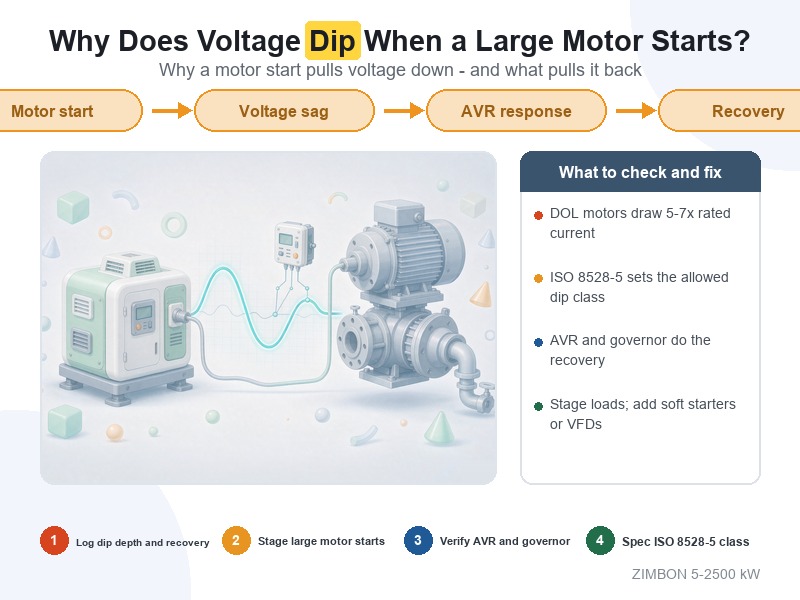
On a specification sheet, a diesel generator set is judged by its rated kilowatts. In daily operation, the hardest moment is often the first second after a large motor energises: lights dim, contactors chatter, drives trip and UPS units log an alarm. The cause is a transient voltage dip - a brief, predictable sag that follows any big step load applied to a standalone power source. Understanding why it happens, and how far it should be allowed to go, is one of the most practical questions a genset owner can ask.
What happens in the first second
An induction motor started direct-on-line draws five to seven times its rated current for the first few cycles, and much of that current is reactive. On a grid, this surge is absorbed by an effectively unlimited source; on a genset, the engine and alternator must supply it alone. Two things happen at once. The engine slows under the sudden torque demand, so output frequency falls, and the alternator terminal voltage sags while the excitation system ramps up to meet the sudden reactive demand. A shallow dip is therefore normal physics, not a defect. What separates a well-specified set from a marginal one is the depth of the dip and the time taken to recover. ISO 8528-5 defines performance classes G1 to G4 for exactly this purpose: each class sets limits for transient voltage and frequency deviation and for recovery time, with G2 permitting a larger excursion than G3, and G4 limits agreed case by case for mission-critical installations.
Two controllers do the recovery work
Recovery is the job of the governor and the automatic voltage regulator (AVR). The governor measures engine speed and increases fuel to pull frequency back to its set point; the AVR senses output voltage and raises excitation current until voltage recovers. A healthy pair restores voltage and frequency within a second or two of a load step, without sustained hunting. When dips grow deeper over months of service, the cause is rarely a single failed part. Common culprits include motors or drives added to the bus after commissioning, two large loads staged to start together, loose AVR sensing connections, or harmonics from UPS rectifiers and variable-frequency drives distorting the waveform the AVR is trying to regulate. Permanent-magnet generator (PMG) excitation, which powers the AVR independently of the main output, is often specified for such harmonic-rich loads because it keeps regulation stable where self-excited systems struggle.
Sizing and operating to keep the dip shallow
Most of the remedy is decided before delivery. Genset manufacturers publish sizing software for motor-starting duty, and working rules of thumb call for a genset-to-motor current ratio of roughly 2.5:1 for motor-only loads, 3:1 with a base load present, and 4:1 or more when sensitive static loads share the bus. A larger machine with a solid base load tolerates the same motor start far better than a marginal one. In operation, staging large starts, fitting soft starters or variable-frequency drives, and keeping about 20 to 25 percent reserve capacity all reduce the depth of the dip. For nonlinear loads, specifiers commonly target total harmonic distortion below 5 percent, supported by PMG excitation or filtering. The stakes are real: industry analysis citing Uptime Institute attributes roughly a third of data-center outages to power-quality events, and a February 2025 Minsheng Securities report estimated the global data-center power-quality market growing from about RMB 6.0 billion in 2025 to RMB 7.6 billion in 2026 as AI densification raises the bar.
A voltage dip at motor start is not a fault to be eliminated but a transient to be engineered. Owners should log dip depth and recovery time during load tests and compare them with commissioning records; a growing trend is an early warning worth acting on. When buying, ask for the ISO 8528-5 performance class and step-load test data, not just the kW rating. Yunnan Zhenbang (ZIMBON) supplies diesel generating sets from 5 kW to 2500 kW on Yuchai, Cummins, Mitsubishi and Volvo power platforms and helps customers match transient response to real load profiles. As factories and data halls fill with motors, drives and rectifiers, the sets that hold voltage steady through the first second will be the ones that keep operations running.
Categories
News
Contact Us
Contact: yuchai Generator Set
Phone: +86 13312561188
Tel: +86-0871-67352758
E-mail: postmaster@zimbon.com
Add: 11th Floor, Office Building C, Shuangcheng Intercity Business Center, No. 8868 Guangfu Road, Guandu District, Kunming City, Yunnan Province, China