Product FAQ
kW or kVA: What Really Limits a Diesel Generator’s Output?
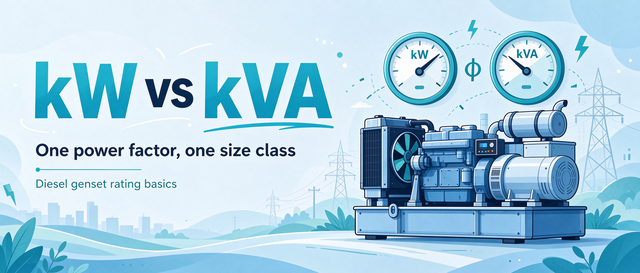
Quotes for data-centre standby gensets now often carry two numbers side by side: one sheet says 800 kW, another says 1000 kVA. Buyers compare the digits, pick the larger one and move on. The two figures are not the same quantity; between them sits a power factor.
1. One equation, two units
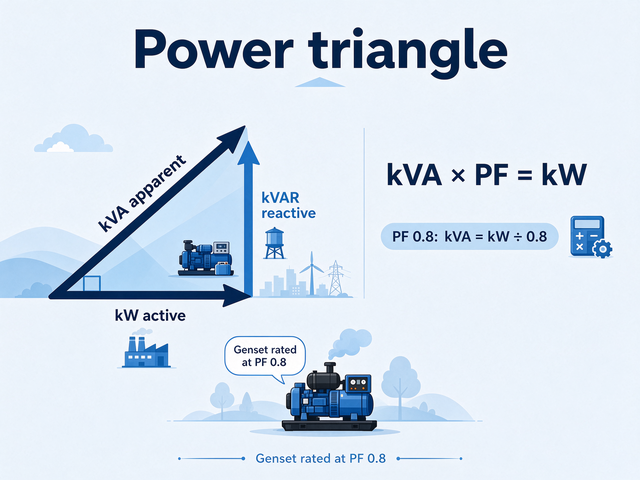
kW is active power, the part that turns into shaft work, heat and useful output. kVA is apparent power, which includes reactive power and sets the current and the heating inside the windings. The link is a single equation: kW = kVA × PF.
Gensets are normally rated at PF 0.8. An 800 kW set therefore corresponds to 1000 kVA, and 1000 kVA × 0.8 brings you back to 800 kW. Multiply down, divide up, and never compare the raw digits.
2. Two limits inside one machine
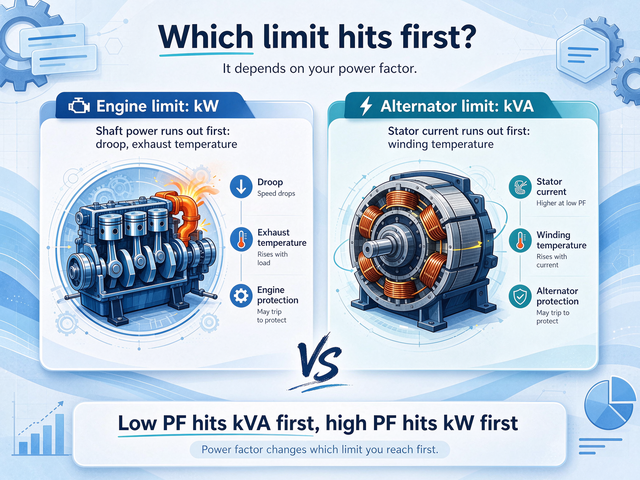
The engine side is rated in kW. Push past it and you get speed droop, frequency sag, higher exhaust temperature and black smoke.
The alternator side is rated in kVA, which limits current. Push past it and winding temperature climbs and insulation ages faster.
Which limit arrives first depends on the load power factor. Pumps, fans and compressors typically sit at 0.75–0.8, lower at part load, so the same kW needs more kVA and the alternator current limit arrives first. UPS, servers and variable-frequency supplies sit at 0.9–1.0, leaving kVA headroom, so the engine kW limit arrives first.
Conclusion: sizing is not picking a bigger number, it is checking both limits and taking whichever comes first.
3. Three steps from kW to kVA
Step one: build the load list in kW. Keep continuous loads (lighting, cooling, servers), intermittent loads (lifts, pumps) and high-inrush loads (motors, estimated at 6–7 times running current for the starting surge) separate. Do not merge them into a single total.
Step two: convert each group with its own PF, kVA = kW ÷ PF. For machine-room loads, PF 0.8 is the safe basis; where measured PF is above 0.9, recheck with the measured value. Then apply a diversity factor of 0.8–0.9 according to the actual duty.
Step three: compare with the nameplate. Both the kW and the kVA figure must exceed the calculated values, then add a 10–20% margin. At altitude or in high ambient temperature, follow the manufacturer's derating curve; at 1,900 m in Kunming this step is not optional.
Frequently asked questions
Our UPS load runs at PF 0.9. Should sizing use 0.8 or 0.9?
Size at 0.8 for margin, then verify against 0.9 at acceptance. After commissioning, log stator current monthly and keep it below the nameplate rating; if motor loads are added later, stay on 0.8.
One supplier quotes kW, another quotes kVA for the same set. Which figure do we accept?
Both. Engine kW proves continuous loading; alternator kVA proves current and temperature rise. Ask each supplier to state the PF 0.8 equivalent so the offers become comparable.
Our set drives motors at PF 0.7. Why does the alternator run hot?
The same kW demands more kVA, so stator current rises and copper loss with it. Keep stator current within the nameplate rating, log winding temperature monthly, and shed load or split it across two sets when it approaches the limit.
After adding capacitor compensation, can the set carry more kW?
Compensation raises PF and lowers kVA demand, but the engine kW ceiling does not move. Over-compensation makes the load capacitive and causes voltage rise and excitation hunting, so switch capacitor banks in stages.
What buyers and operators should do
Fix the rating basis before negotiating: prime or standby, plus the PF equivalent. Sort the load list by power factor instead of lumping motors and servers together. On site, watch stator current rather than the kW meter alone. Stack altitude and temperature derating, and keep the margin.
Look at the nameplate on your set: what do the kW and kVA figures say, and do they line up at PF 0.8?
Categories
News
Contact Us
Contact: yuchai Generator Set
Phone: +86 13312561188
Tel: +86-0871-67352758
E-mail: postmaster@zimbon.com
Add: 11th Floor, Office Building C, Shuangcheng Intercity Business Center, No. 8868 Guangfu Road, Guandu District, Kunming City, Yunnan Province, China