Product FAQ
Why Does One Generator Carry Two Power Ratings?
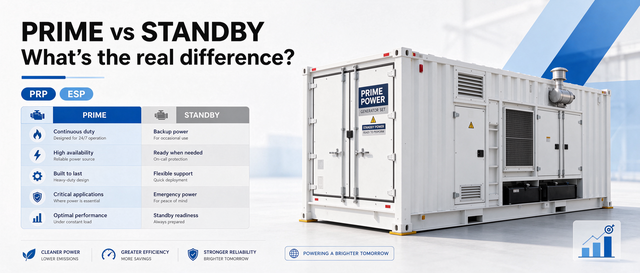
With data center backup orders still tight, the same generator often appears on a quotation with two numbers: 500 kW and 550 kW. The machine is identical. What differs is the rating basis.
1. Two ratings answer one question: can it run continuously?
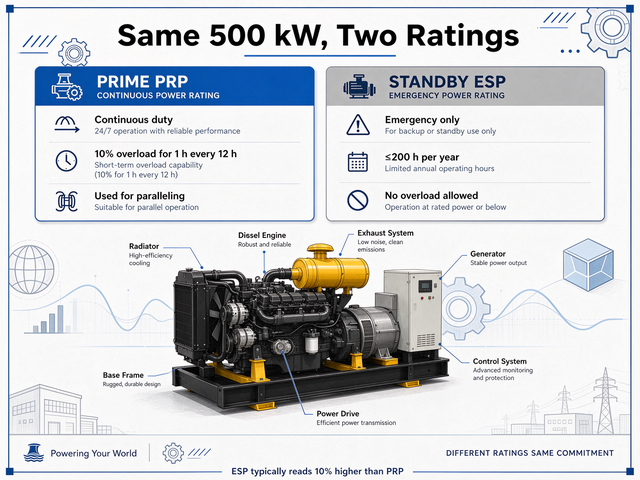
ISO 8528-1 separates prime power (PRP) from standby power (ESP). PRP allows continuous operation under varying load, with a 10% overload for one hour in every twelve. ESP is for mains failure only, is normally limited to about 200 operating hours a year, and does not permit overload.
On the same unit, the ESP figure usually reads about 10% higher than PRP. So when a quotation says “500 kW”, the first question is whether that number is prime or standby.
Conclusion: specify PRP when the load runs continuously or when units are paralleled; ESP is acceptable for short outage duty, but never use an ESP figure for sustained loading.
2. The 10–20% gap shows up in price and acceptance
A quotation with a single power number is where trouble hides. Pricing at the ESP figure looks cheaper for the “same rating”, but it has quietly moved the unit up one class; under sustained load the set then runs above its rating, and exhaust temperature, oil temperature and liner wear all rise.
Two more quantities get mixed up: kW and kVA. kVA times power factor (typically 0.8) gives kW. UPS systems in data centers often run above 0.9 power factor, so select by kVA but verify by kW, otherwise capacity looks sufficient while power is not.
Conclusion: put rating definition, power factor and site conditions in the contract, and quotations become comparable.
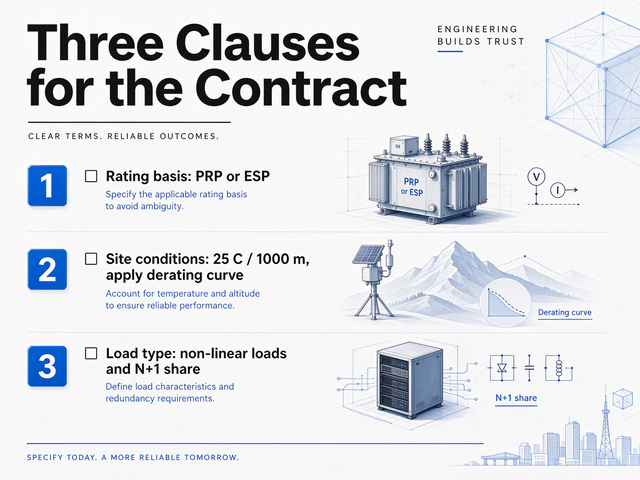
3. Three clauses to write into the contract
First, rating basis. State whether the figure is PRP or ESP under ISO 8528-1, with annual hour limits and overload terms, not just “500 kW”.
Second, site conditions. Ratings are usually referenced to 25 °C, 1,000 m altitude and 30% relative humidity. Kunming sits near 1,900 m, where derating curves typically cost 4–6% per additional 1,000 m, and summer ambient temperature takes another step.
Third, load type. Non-linear loads such as UPS, VFDs and elevators must be named in the technical clauses, with excitation and winding temperature rise verified accordingly; for paralleled systems, state the per-unit load share under N+1 rather than only total capacity.
Conclusion: without these three clauses, acceptance becomes a matter of opinion.
Frequently Asked Questions (Service and Selection)
Our 500 kW unit at a 1,900 m site in Kunming delivers only 85%. Is it faulty?
Usually it is derating, not a fault. The reference is 25 °C and 1,000 m; at 1,900 m the curve takes 4–6%, and 35–40 °C intake air takes another step, so 10–15% below nameplate is normal. Check the nameplate conditions and the derating curve, then watch exhaust temperature, oil temperature and frequency: if all three are stable, the machine is fine.
The unit runs at 25% load all year. Can it still take full load?
Yes, but it needs practice first. Sustained operation below 30% load causes wet stacking as unburned fuel builds carbon in the cylinders. Step up to 50% load for two hours, then to 80%, watching exhaust temperature and smoke; after that, run a loaded test every quarter and change oil at 250–300 hours or six months.
For a 2 MW data center tender, should we specify PRP or ESP?
Specify PRP, and add the ISO 8528-1 definition, annual hour limits and the 10% overload for one hour in twelve. For N+1 paralleling, calculate available capacity from per-unit PRP rather than adding ESP figures, or the redundancy is not real.
The quote says only “500 kW”. How do I know it is the standby figure?
Three checks: see whether the nameplate carries both PRP and ESP; multiply kVA by 0.8 and compare with kW; ask the supplier for the rating conditions and derating curve. If any one is missing, treat the number as ESP and negotiate from there.
What buyers and operators should take away
A power rating is not a parameter, it is a promise about sustained loading. Asking one question, PRP or ESP, is worth more than a five percent discount; recording load factor and loaded-test results tells an operator where the real ceiling of the machine sits.
Which figure is on the nameplate of the unit you operate today, PRP or ESP?
Categories
News
Contact Us
Contact: yuchai Generator Set
Phone: +86 13312561188
Tel: +86-0871-67352758
E-mail: postmaster@zimbon.com
Add: 11th Floor, Office Building C, Shuangcheng Intercity Business Center, No. 8868 Guangfu Road, Guandu District, Kunming City, Yunnan Province, China