Product FAQ
Why Do Data Centers Need a 10-Second Start?
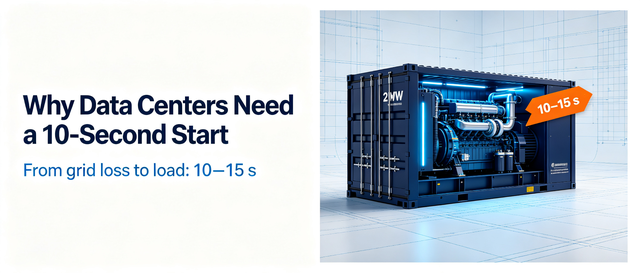
In November, CCTV Finance reported that orders for high-power diesel generator sets used in data centers are now booked into October 2027, and domestic demand for 2026 is expected to exceed 6,000 units. For these machines the critical figure is not the kW rating. It is ten seconds.
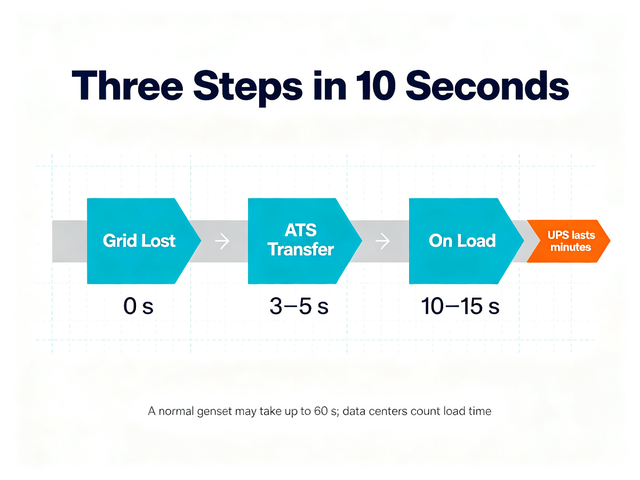
1. Ten seconds means on load, not ignition
An ordinary standby genset is usually allowed up to 60 seconds to start. A data-center unit is required to start, build voltage, close the breaker and carry load within 10 to 15 seconds, and then run stably. The reason is simple: the UPS battery only bridges a few minutes, so a late genset means dropped servers.
That is why the wording matters. “Start time” measured from pressing the button to firing is not the same as “grid loss to load”. The two figures can differ by a factor of two.
2. Four packages that hold the ten seconds
Jacket water heater. A hot-standing set keeps block water at around 40°C (35–45°C is normal) all year. A cold engine can easily double the start time, so the heater stays energised in summer as well.
Starting battery. At −5°C usable capacity drops to roughly 70 percent, and a slow crank turns into repeated failed attempts. Test voltage and internal resistance every quarter and replace the battery below 80 percent of rated capacity.
Intake and oil preheat. In cold or high-altitude sites, water temperature alone is not enough; intake air temperature and oil viscosity both delay ignition.
Parallel synchronising. A single unit closes its breaker in 3 to 5 seconds. When two or more 2 MW units run in parallel, synchronisation adds another 3 to 8 seconds. That interval has to be counted inside the ten seconds, which is why data-center packages use fast synchronising controllers and prove them with a 0–100 percent step-load test, not a no-load run.
3. Three clauses to write into the contract
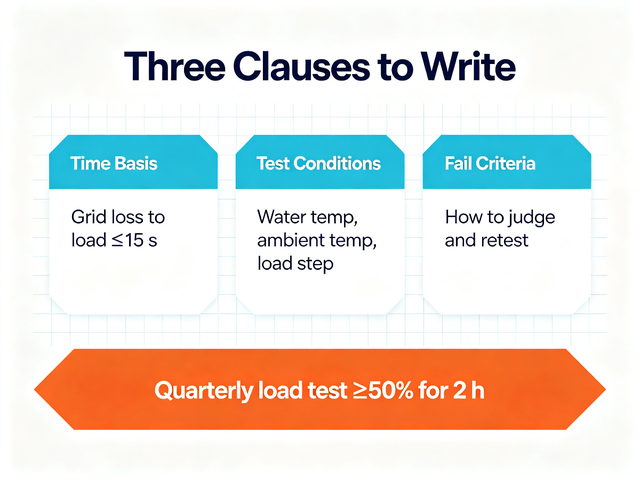
Time basis: write “grid loss to load ≤15 s (or ≤10 s)”, never “start time ≤10 s”.
Test conditions: state water temperature, ambient temperature and the load step. A cold start at low ambient with a full step load can take twice as long as a warm no-load start.
Fail criteria: state how the time is recorded (controller log or transient recorder), how many retests are allowed, and what happens if the limit is missed. Without these three lines, acceptance turns into an argument.
FAQ (maintenance and selection)
On a 2 MW data-center unit in Kunming, what block water temperature should the jacket heater hold?
Around 40°C; 35–45°C is acceptable. Below 30°C the start time lengthens noticeably. Keep the heater energised all year and check the heating element and thermostat before winter.
How often should starting batteries be tested on a 10-second genset?
Every quarter, measuring static voltage and internal resistance. Replace the battery when capacity falls below 80 percent of rated value. At −5°C expect only about 70 percent usable capacity, so the pre-winter test is essential.
Should a tender say “load” instead of “start”?
Yes. Write “grid loss to load ≤10 s” and require a witnessed step-load test record from the factory or site. Otherwise “firing” and “on load” will be argued at acceptance.
Does a 500 kW site genset also need the ten-second package?
Only where UPS ride-through is short and the load cannot stop. For construction sites, lighting and pumps, 30 to 60 seconds is enough; insisting on ten seconds adds cost for preheat, low-temperature batteries and fast-start controls.
What buyers and operators should take away
This order wave has turned start time from a line in a datasheet into a hard metric. Writing the time basis and test conditions clearly costs nothing and saves more than buying an extra unit. On the operations side, treat the jacket heater and the starting battery as part of the ten seconds; otherwise the gap only shows up on the day the grid fails.
What is your measured time from grid loss to load?
Follow for the site acceptance checklist for ten-second starting; comment “checklist” and I will send it to you.
Categories
News
Contact Us
Contact: yuchai Generator Set
Phone: +86 13312561188
Tel: +86-0871-67352758
E-mail: postmaster@zimbon.com
Add: 11th Floor, Office Building C, Shuangcheng Intercity Business Center, No. 8868 Guangfu Road, Guandu District, Kunming City, Yunnan Province, China