Product FAQ
How Does Altitude Affect Diesel Generator Output?
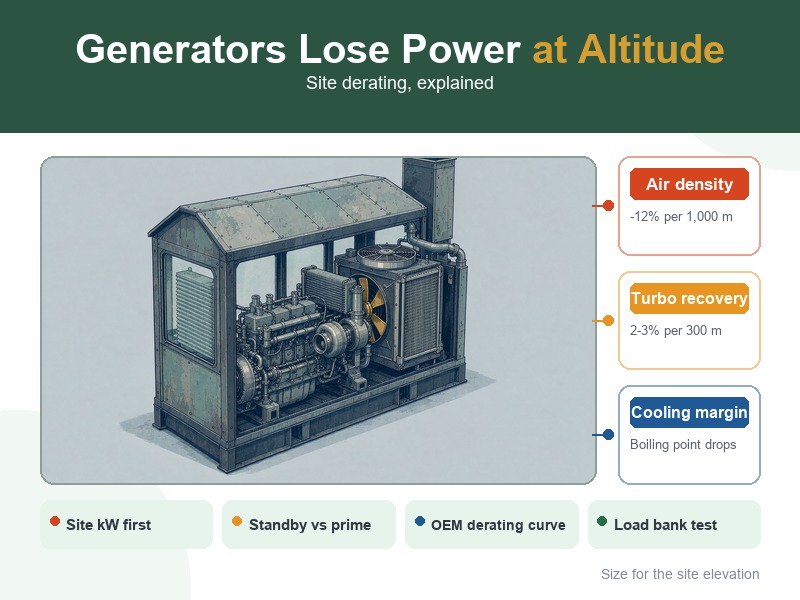
Diesel generator ratings are quoted against fixed reference conditions - typically 100 kPa atmospheric pressure, 25 degrees Celsius and 30 percent relative humidity under ISO 8528-1. Move the same set to a construction site 2,000 metres above sea level and the kilowatts printed on the nameplate are no longer the kilowatts the machine will deliver. For buyers in plateau regions, understanding altitude derating is often the difference between a set that carries the load and one that smokes, trips or fails to start reliably.
Why thinner air costs kilowatts
Air density falls by roughly 10 to 12 percent for every 1,000 metres of elevation. A diesel engine takes in a fixed volume of air each cycle, so less oxygen means less fuel can be burned completely - and maximum output drops with it. Naturally aspirated engines follow the density curve almost exactly, losing roughly 3 to 4 percent per 300 metres above 1,000 metres on many published curves. Turbocharged engines recover much of the loss by compressing the intake air, and turbocharged aftercooled versions hold their rating best; manufacturers commonly quote about 2 to 3 percent per 300 metres above 1,000 metres for such units. The exact figure is always model-specific, because turbo matching, intercooler sizing and injection calibration all differ between engines of the same rating.
Heat, smoke and cooling
Altitude changes how a set behaves, not just how much it produces. Thinner air moves less heat, so radiator cooling margins shrink precisely where ambient temperatures can still climb; the coolant boiling point also drops, to roughly 93 degrees Celsius at 2,000 metres, which makes an adequately sized pressurised cooling system essential. On mechanically governed engines, unchanged fuel delivery against reduced air can cause over-fuelling - black smoke, elevated exhaust temperatures and carbon build-up - unless the injection pump is altitude compensated. The alternator is affected too, since it is air-cooled and its temperature rise increases as the cooling air thins.
Sizing for the site, not the catalogue
A practical planning rule: site output equals rated output multiplied by (1 minus the altitude derate minus the temperature derate). At 2,500 metres and 40 degrees Celsius, a conservative estimate puts the combined derate near 17 to 18 percent, so a site that needs 500 kW should be quoted a set of roughly 600 kW rating. Buyers should also state the duty - standby, prime or continuous - because prime ratings already assume an average load near 70 percent over 24 hours.
Four steps keep the process safe. Give the manufacturer the exact site elevation, ambient temperature range, humidity and load profile. Request the altitude and temperature corrected output curve for the specific engine model, not a generic table. Keep a margin of 10 to 15 percent for future load growth and engine ageing. Finally, validate at commissioning with a load bank run under site conditions, and log exhaust temperatures during the test.
What plateau projects should expect
Elevation is not an edge case in southwest China. Kunming sits at about 1,890 metres, much of the Yunnan-Guizhou plateau lies between 1,500 and 2,500 metres, and mining and telecom sites further west can exceed 4,000 metres. ZIMBON, based in Kunming, configures diesel generator sets powered by Yuchai, Cummins, Mitsubishi and Volvo engines for exactly these conditions - high-altitude turbo matching, oversized cooling packages and a site-specific derating curve issued with every quotation - so the output promised on paper is the output delivered at the customer's elevation.
Categories
News
Contact Us
Contact: yuchai Generator Set
Phone: +86 13312561188
Tel: +86-0871-67352758
E-mail: postmaster@zimbon.com
Add: 11th Floor, Office Building C, Shuangcheng Intercity Business Center, No. 8868 Guangfu Road, Guandu District, Kunming City, Yunnan Province, China