Product FAQ
Why Do Standby Generators Need Load Bank Testing?
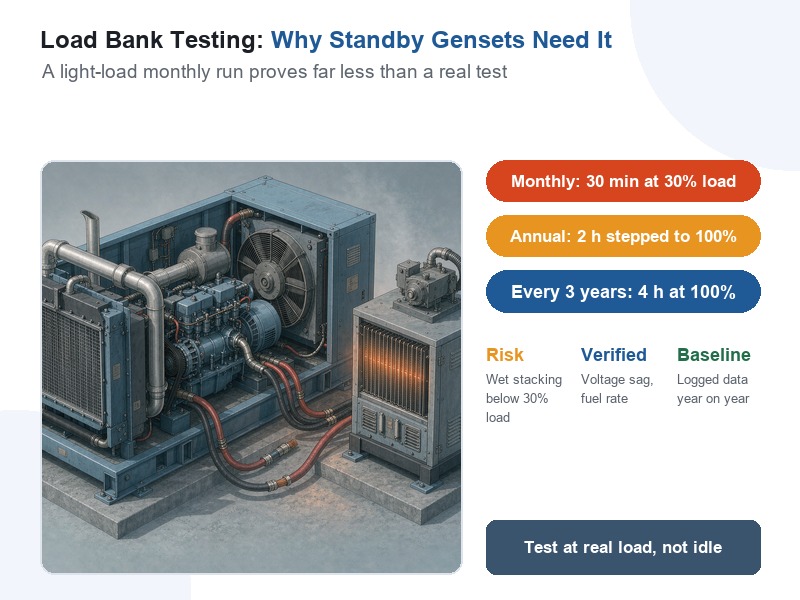
A standby generator that starts on command and runs for half an hour is not the same as a generator that can carry the building. Between those two states sits load bank testing: connecting a controlled, artificial electrical load to the set so its engine, alternator and cooling system are exercised the way they will be during a real outage. For facility managers and specifiers, it is one of the few maintenance practices that turns a paper guarantee into measured evidence.
Why an unloaded run proves so little
Most monthly exercise routines start the set, let it run against the building's normal load, and shut it down. In a data center or hospital, that normal load is often only 15-30% of nameplate, because the utility is still supplying the site. Diesel engines are not designed to spend their lives at that level. Below roughly 30% load, combustion temperatures fall, fuel burns incompletely, and unburned fuel and carbon accumulate in the exhaust system, turbocharger and after-treatment - the condition known as wet stacking. It shows up as black smoke, rising oil consumption, fouled injectors and, eventually, a set that cannot reach rated output when it matters.
An unloaded run also leaves the interesting questions unanswered. How far does voltage sag when a large motor load is applied in one step? Does frequency hold when the cooling plant comes online? Does the radiator cope at full load in high ambient temperature? Those behaviors only appear under real load, which is exactly what a normal monthly test never provides.
What a proper load bank test looks like
A resistive load bank converts electrical energy into heat and dissipates it, so the generator can be loaded to any level independent of the building. Reactive banks add inductors and capacitors to exercise the set at realistic power factors. A standard annual profile is stepped: about 30 minutes each at 25%, 50% and 75% of rating, then a full hour at 100% - a minimum of two hours of loaded running, with voltage, frequency, fuel consumption, exhaust temperature, coolant temperature and oil pressure logged at every step. The numbers matter more than the pass/fail outcome: they become the baseline against which next year's test is compared, so gradual degradation in voltage regulation or cooling becomes visible long before it becomes a failure.
How often, and by whose rules
In North America, NFPA 110 sets the cadence for emergency power supply systems. Its monthly operational test must run at least 30 minutes at no less than 30% of nameplate; where site load cannot reach that threshold, an annual load bank test compensates. The standard also calls for a four-hour continuous run at rated load every three years, plus an acceptance test before a new system enters service. Elsewhere, the same logic is embedded in the ISO 8528-1 rating system: an emergency standby (ESP) rating assumes no more than 200 hours per year at an average of 70% of rating, prime (PRP) allows unlimited hours with a 70% average load factor, and data centre power (DCP) ratings assume continuous duty. Running a set outside the duty its rating assumes is how reliability problems - and warranty disputes - begin.
Where facilities get caught
The common failure is not a missing test but a test that never leaves the light-load zone. A 2,000 kVA set serving a facility that draws 400 kVA will pass every monthly run yet may never have delivered a fifth of its capability. Paralleled systems add a second blind spot: load sharing between units can drift without anyone noticing until a real transfer event puts both under demand. A load bank is the practical way to discover that on a scheduled afternoon instead of during a grid outage.
The specification angle
Buyers can design most of this problem out. Size the set for its intended duty rather than the largest number on the datasheet, confirm the cooling package is rated for sustained full load at site ambient, and make sure the controller logs the test data your records require. ZIMBON builds diesel generator sets from 5 kW to 2,500 kW on Yuchai, Cummins, Mitsubishi and Volvo platforms and supports load bank testing and documentation for export projects. A generator is only as reliable as the last time it was asked to prove itself - under load.
Categories
News
Contact Us
Contact: yuchai Generator Set
Phone: +86 13312561188
Tel: +86-0871-67352758
E-mail: postmaster@zimbon.com
Add: 11th Floor, Office Building C, Shuangcheng Intercity Business Center, No. 8868 Guangfu Road, Guandu District, Kunming City, Yunnan Province, China