Industry news
Hybrid Microgrids Change How Gensets Are Specified
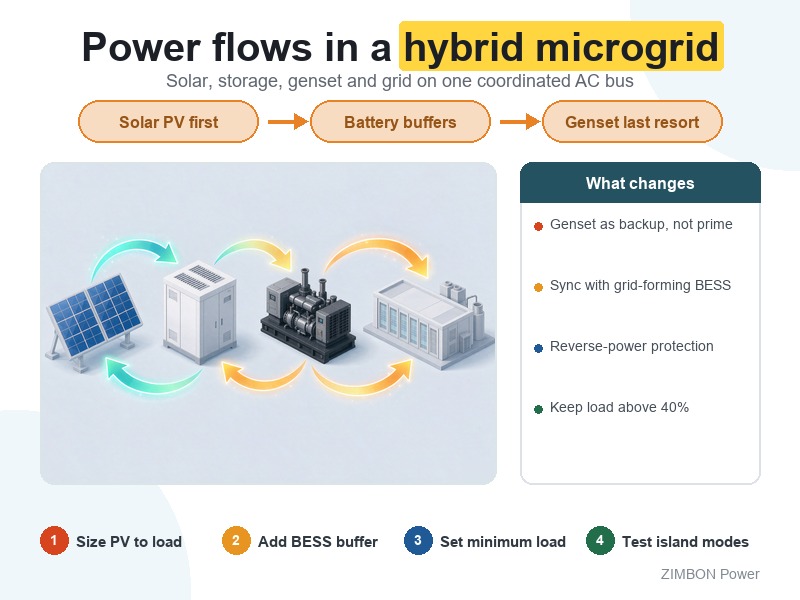
For decades a diesel generator set has been specified as a self-contained asset: an engine, an alternator, an automatic transfer switch and a fuel tank sized for a fixed runtime. That assumption is now being tested. As data centers, industrial parks and remote facilities add solar arrays and battery energy storage, the genset is increasingly designed as one node inside a coordinated hybrid microgrid rather than as the sole source of backup power. The shift is less about replacing diesel than about redefining what a generator set has to be able to do.
Market data points to integration, not displacement. MarketsandMarkets, in a June 2026 report, valued the global data center generators market at USD 8.57 billion in 2026 and projected USD 9.79 billion by 2031, a modest 2.7 percent CAGR. Diesel units still account for the largest share, about USD 5.79 billion in 2026, and the above-3 MW class is expected to grow fastest at roughly 5.4 percent CAGR. The same report identifies edge computing as a driver of compact, modular, fast-start systems with remote monitoring and hybrid energy integration. Mordor Intelligence estimates that hybrid configurations already represented 56.19 percent of the data center distributed energy resources market in 2026. Polaris Market Research puts diesel at 81.24 percent of the fuel-type segment in 2025, while forecasting the dual-fuel and HVO-compatible segment to grow at 5.22 percent CAGR. In short, the installed base is not vanishing; the specification around it is changing.
The controller has become the critical component. A documented ComAp project at a beachfront resort in Nicaragua shows the architecture in practice. An InteliNeo 6000 microgrid controller supervises roughly 1,125 kWp of photovoltaic array, a 1.2 MW / 4.5 MWh battery system and two diesel gensets rated about 424 kW and 350 kW, with a separate InteliMains 1010 handling utility interconnection. The battery was approved for continuous grid-forming operation in parallel with the gensets, and after commissioning the engines were reserved largely for backup duty while storage managed peak-demand charges. Rehlko introduced its APM804 Global Systems Controller in May 2026 for applications ranging from a single set to complex grid-parallel systems, reflecting how paralleling and load-sharing logic is moving to the centre of system design. That logic matters: engineering guidance for solar-diesel hybrids warns that when photovoltaic output exceeds site load, reverse power can feed back into a running machine, and a reverse-power relay is considered mandatory. The same guidance recommends keeping a genset above roughly 40 percent load whenever it runs to avoid wet stacking.
Sizing and procurement are changing with it. Hybrid plants are typically configured with PV covering about 50 to 70 percent of daily energy and a battery sized for the night load plus one full charging cycle; done correctly, such plants can cut diesel consumption by 55 to 70 percent. Designers also choose between AC-coupled layouts, which suit retrofits of an existing standby set, and DC-coupled layouts, which are more efficient for new builds. Larger projects are diversifying the generation mix as well: Wartsila recorded an April 2026 order for 412 MW of engine power for a hyperscale campus in Ohio, while Rolls-Royce delivered mtu emergency generators with verified environmental product declarations to a European operator in December 2025, a sign that lifecycle emissions documentation is becoming a procurement item alongside rating and price.
None of this removes the need for a dependable engine. Mission-critical sites still require a set that starts on demand, accepts load within seconds and sustains it for the full outage, and that duty falls on the diesel unit when storage is depleted and the grid is unavailable. Buyers should therefore treat the genset as a specified system element rather than a commodity: confirm the rating against the site load step, verify paralleling and reverse-power protection, agree the minimum loading strategy, and document fuel compatibility where HVO or dual-fuel operation is planned. Yunnan Zhenbang (ZIMBON) supplies diesel generating sets from 5 kW to 2500 kW across Yuchai, Cummins, Mitsubishi and Volvo platforms and advises customers on hybrid-ready controls. As hybrid microgrids move from pilot projects to standard practice, the sets that integrate cleanly will be the ones that keep their value.
Categories
News
Contact Us
Contact: yuchai Generator Set
Phone: +86 13312561188
Tel: +86-0871-67352758
E-mail: postmaster@zimbon.com
Add: 11th Floor, Office Building C, Shuangcheng Intercity Business Center, No. 8868 Guangfu Road, Guandu District, Kunming City, Yunnan Province, China