Industry news
Stage V Is Knocking: Mobile Gensets Enter Emission Rules
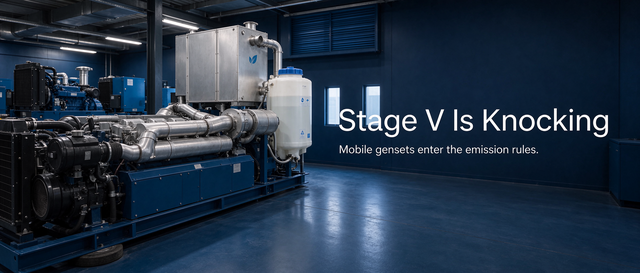
In June 2026 the Ministry of Ecology and Environment opened public consultation on Stage V pollutant limits and measurement methods for non-road mobile machinery and its engines. The draft explicitly names mobile generator sets in its scope.
Conclusion: this is not a case of buying one more aftertreatment box. Procurement clauses, maintenance intervals and registration duties all change at the same time, and the earlier you adjust, the less it costs.
1. Mobile gensets are named, and the China IV buffer is gone
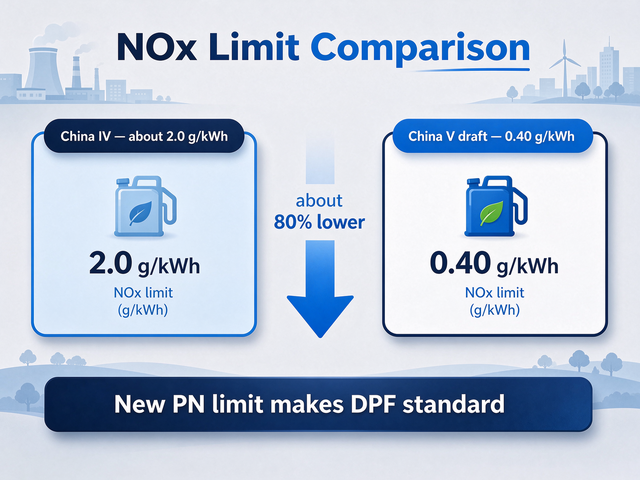
Public readings of the draft put the NOx limit for the 56–560 kW band at 0.40 g/kWh, down from roughly 2.0 g/kWh under China IV, a cut of about 80 percent. Particulate limits tighten by 30 to 55 percent across all bands, and a new particle number limit effectively makes a DPF mandatory rather than optional.
What to do now: stop writing "meets China IV" as the whole emission clause in a tender. Split it into three parts — emission stage, aftertreatment configuration (SCR, DPF and ammonia slip catalyst named individually), and the type-test report number.
2. Aftertreatment becomes standard, so maintenance intervals must move
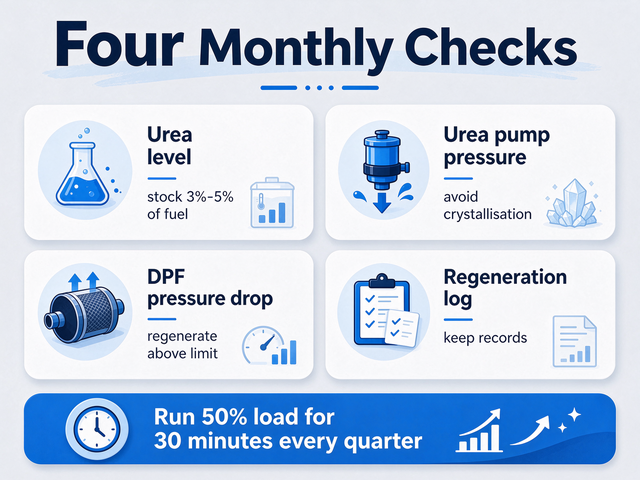
An SCR-equipped set carries a system that needs looking after. Urea is not a fill-and-forget item: replenish against the maker's consumption curve, commonly in the range of 3 to 5 percent of fuel consumption, because a dry tank derates the engine. Urea pumps and injectors crystallise, so let the system complete its purge before shutdown. DPF regeneration needs exhaust temperature, and standby sets that run at light load are the ones that fail to regenerate fully, leaving pressure drop climbing.
What to do now: put urea level, urea pump pressure, DPF pressure drop and the date of the last regeneration on the monthly checklist. Every quarter, run standby sets at 50 percent load or above for 30 minutes to give regeneration a chance.
3. Above 19 kW, connectivity and registration land on the user
The draft lowers the PEMS test threshold from 37 kW to 19 kW, extends remote emission monitoring to machinery above 19 kW, and relaxes test conditions to 2,400 m altitude and -7 to 40 degrees Celsius. Combined with coding registration already enforced in many provinces, the user now carries a ledger duty.
What to do now: register the machine code before it enters the site, and record emission stage, aftertreatment model and urea tank capacity in the equipment ledger. Export operating and emission data once a month and keep the file. For rented units, ask for the previous registration and the last three repair records; no documents, no contract.
4. FAQ: maintenance and selection
With an SCR fitted to a 500 kW site set in Yunnan, how often should urea be checked and how much is consumed? Budget 3 to 5 percent of fuel consumption as stock, check the level weekly and pump pressure monthly; in dusty sites clean the nozzle every 500 hours.
At 1,900 m altitude, should DPF checks be shortened on an 800 kW set? Yes. Thinner air lowers exhaust temperature and narrows the regeneration window, so move pressure-drop checks from every 250 hours to every 150 hours and arrange a loaded regeneration once the limit is reached.
For a 300 kW mobile set tendered in Kunming for 2027, should the specification already say Stage V? Better to write an automatic switch clause: deliver to China IV now, but require a written commitment that the same model can be upgraded, with the upgrade price locked into the contract.
For a 2 MW data-centre set exported to Vietnam, should emission configuration follow China IV or wait for Stage V? Export follows the destination market, not the domestic stage; state the applicable local basis and test report in the contract, and never treat China IV as a universal passport.
5. What buyers and operators should take away
Emission upgrades mostly change the cost structure. The machine itself moves less than the running bill: urea, filters, regeneration downtime, registration and data retention. Fold five years of urea and filter cost into total cost of ownership and the comparison looks very different from a unit-price table. Operators should treat aftertreatment health as a basic check, like engine oil — a set can start, hold load and still be out of compliance.
Does your current tender still say "meets China IV", or has it already been broken down into the three aftertreatment items?
Categories
News
Contact Us
Contact: yuchai Generator Set
Phone: +86 13312561188
Tel: +86-0871-67352758
E-mail: postmaster@zimbon.com
Add: 11th Floor, Office Building C, Shuangcheng Intercity Business Center, No. 8868 Guangfu Road, Guandu District, Kunming City, Yunnan Province, China