Industry news
Lead Times to 2028: The 10 Seconds Data Centres Test
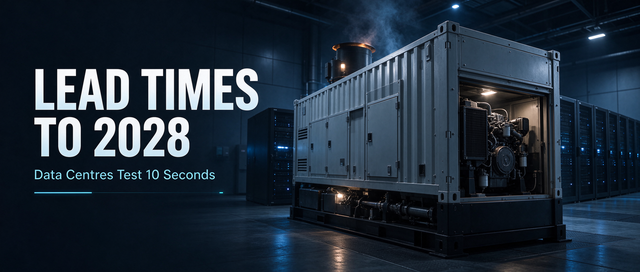
On 17 November, CCTV Finance reported that large diesel generator sets are now in short supply as AI computing centres come online in clusters, with leading manufacturers' order books running into 2027 and even 2028. The China Internal Combustion Engine Industry Association expects domestic data-centre genset demand to pass 6,000 units in 2026, a market worth over RMB 10 billion. Behind the backlog, the real qualification is not displacement — it is those 10 to 15 seconds.
1. Ten to fifteen seconds is a four-link chain
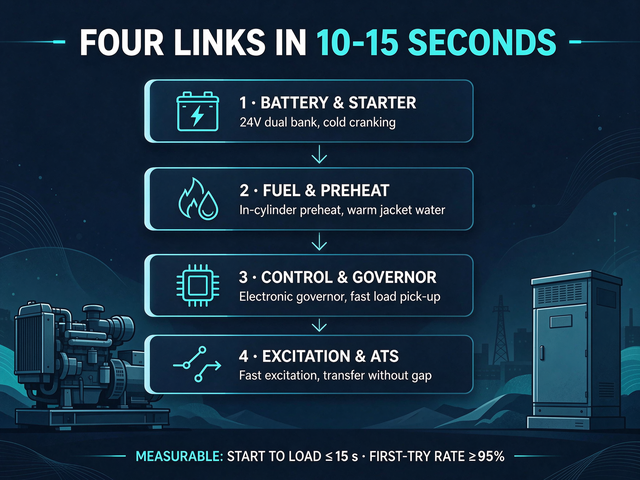
A standby set for an ordinary building only has to start within a minute. A data centre asks for 10 to 15 seconds to start and carry load stably. That window is not bought with a bigger engine; it is the sum of four links running together. The battery and starter must deliver enough cranking current from cold, which is why 24V dual battery banks are common. Fuel supply and preheat must make the first compression fire, using in-cylinder preheaters and warm jacket water. Control and governing must bring the set to rated speed and accept load quickly. Excitation and the ATS must put power onto the load with voltage dip inside what the upstream equipment tolerates. If any one link loses a second, the whole window is missed.
Takeaway: when you write "10–15 seconds" into a specification, turn it into measurable terms such as "start to load in ≤15 s, first-try success rate ≥95%", and ask the supplier for tested curves and an on-site acceptance procedure — not just a nameplate rating.
2. With lead times at 2028, manage delivery risk in writing
When lead time stretches from a few months to a year or two, the buyer's real fear is a live data hall with no generator on site. Three practical moves: write staged delivery and "each unit goes into parallel operation on arrival" into the contract, so N+1 modular sets replace one oversized unit and the first arrivals carry part of the load; lock the long-lead components — starters, ECU, excitation boards and paralleling switchgear are often the real schedule blockers and should be ordered with the set, with a spare parts list agreed up front; and use rental sets as a bridge if needed, but put the rental unit's start time and load capability in writing so the bridge does not become the weakest link.
Takeaway: a contract clause for staged delivery and on-arrival commissioning is safer than waiting for one 2 MW unit.
3. A few dozen running hours a year — low load is the real risk
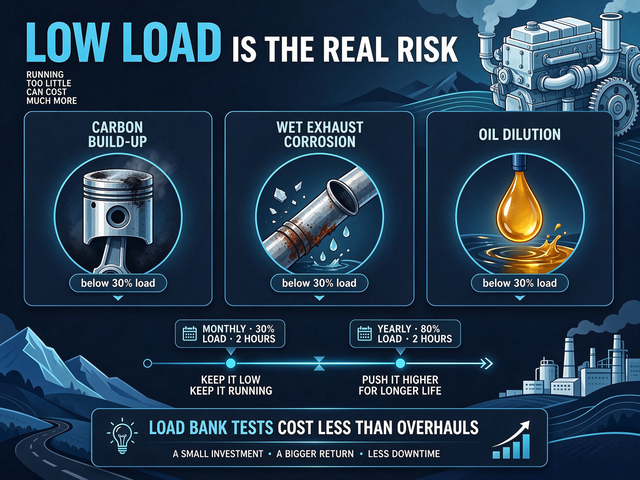
A data-centre standby set barely runs: apart from monthly tests, it may accumulate only a few dozen hours a year. Running below 30% of rated load for long periods brings three quiet damages — carbon build-up in cylinders and turbocharger, low-temperature wet corrosion in the exhaust, and oil dilution with degraded lubricant. None of them raises an alarm immediately; they surface together the one time the grid actually fails.
A workable rhythm: once a month, run at no less than 30% rated load for two hours using a load bank; once a year, run at no less than 80% load for two hours with step-load and step-unload tests to verify dynamic response; change oil on both hour and calendar criteria — typically 250 to 500 hours or 12 months, per the manufacturer's manual; and test stored fuel quarterly for water and microbial growth, rotating stock within 6 to 12 months.
Takeaway: putting "30% monthly and 80% yearly load tests" into the maintenance plan costs far less than an unplanned overhaul.
4. FAQ: maintenance and selection
Does a 2,000 kW standby set at 1,900 m altitude in Kunming need derating? Yes. Turbocharged units typically lose about 2–3% of rated power per 1,000 m of altitude, so roughly 4–6% at 1,900 m, plus an intake-air temperature correction. Calculate with the manufacturer's high-altitude curve instead of selecting from the sea-level nameplate.
A 2 MW set only ever carries 15% load — how should the load test be run without harming it? Warm it up at no load for 5–10 minutes first, then step up to 30% rated load and hold for two hours; once a year go to 80% load for two hours with step-load and step-unload. Never put a cold engine straight onto a heavy load.
For a 500 kW standby set in Yunnan, should the 10-second start be written into the tender? Yes. Specify "start signal to stable load in ≤10 s, first-try success rate ≥95%" and agree the number of acceptance tests, the pass criteria and the remedy for failure.
If lead time is 18 months, one 2 MW unit or four 500 kW in parallel? Prefer N+1 parallel. Staged arrivals can be commissioned in stages, a single unit under service does not take the whole plant down, and capacity can grow later; the cost is more floor space, paralleling commissioning and more maintenance points, so switchgear and load-sharing strategy must be planned.
What this means for buyers and operators
Count the whole-life cost. The purchase price is only the first invoice; lead time, starting reliability, low-load maintenance intensity and spare-part response all turn into money in the following years. For the same budget, favour the solution that leaves margin in the starting chain and can source spares locally.
How many minutes is your standby set designed to start in today — and would your current configuration pass a 10-second acceptance test? Tell us the model, the power range and the altitude, and we will walk through the starting chain with you.
Categories
News
Contact Us
Contact: yuchai Generator Set
Phone: +86 13312561188
Tel: +86-0871-67352758
E-mail: postmaster@zimbon.com
Add: 11th Floor, Office Building C, Shuangcheng Intercity Business Center, No. 8868 Guangfu Road, Guandu District, Kunming City, Yunnan Province, China