Industry news
Winter Peak Demand: Gensets Move from Backup to Dispatchable
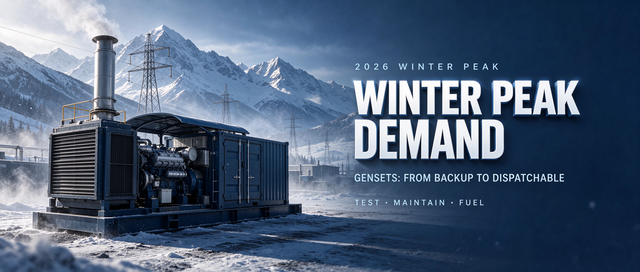
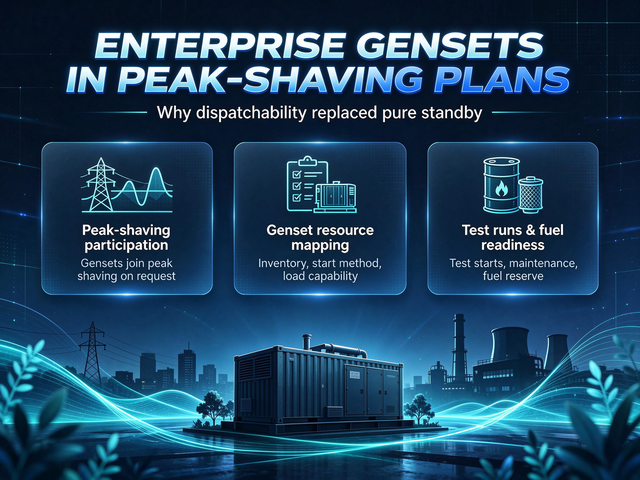
On November 3, Xiaoshan District of Hangzhou released its 2026 winter peak-demand power plan, calling on data centers' diesel gensets to join peak shaving, on enterprises to map their own genset resources, and on operators to run test starts, maintenance and fuel stockpiling. On November 13, Henan's energy supply meeting likewise required emergency standby units to be ready "whenever dispatched". The diesel generator is changing identity: from a last-resort line of defense to a dispatchable peaking resource.
1. A new identity: from last line of defense to dispatchable mobile load
In the past, gensets were remembered only when the grid went dark. Today the documents say "participate in peak shaving" and "deliver peak output". The difference is fundamental: emergency duty is low-frequency and passive, and success means one clean start; dispatch duty is high-frequency and active, and success means the unit can come online, carry the load, and stop on command.
For owners, the question shifts from "should we buy one" to "will it answer when called": how many units, unit rating, automatic start, ATS reliability, real load capability, and how much fuel is actually in the tank. Data centers have one more question: when gensets join peak shaving, how do they rank against UPS, energy storage and load priority?
Takeaway: inventory before procurement. Put unit list, start method, load capability and fuel duration on one sheet. It is far more useful than arguing about brands.
2. Winter's real risk is not an outage, but a unit that will not start
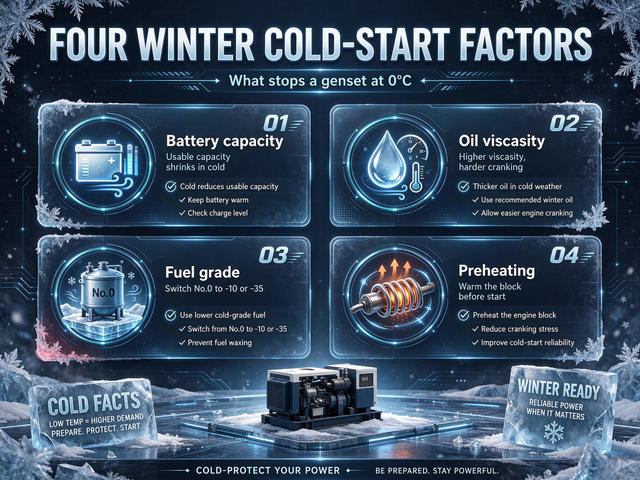
Low temperature hits a genset three ways. Battery usable capacity shrinks, so cranking current falls short. Lube oil viscosity rises, cranking resistance climbs and the engine cannot spin up. Diesel waxes: No.0 grade barely flows near 0°C, and operators should switch to -10 or even -35 grade based on local extreme lows.
Add long idle periods: battery self-discharge, dead controller batteries, oxidized fuel. Many units do not fail while running; they fail when they are called.
Takeaway: before winter, run a loaded test, not a no-load listen. Run at 30% load or more for 30 minutes and watch coolant temperature, oil pressure, frequency, exhaust color and alarms, while recording start time.
3. Fuel and the fuel path: the second hidden risk
Condensate in the tank, water in the fuel-water separator and waxed filters are the three most common winter fuel-path faults. Diesel stored too long oxidizes and gums up, clogging filters and injectors. A half-empty tank breathes in moisture; condensate settles at the bottom and is drawn into the fuel path first.
Reserve sizing should match the application: data centers commonly hold 24 to 96 hours at full load, while general commercial and industrial sites are safer at 72 hours.
Takeaway: keep a minimum of 72 hours. Before winter, drain water and sludge, change filters and test fuel once a quarter. Do not wait for an alarm.
Three takeaways for buyers and operators
Inventory your units, run loaded tests, and treat fuel and spare parts as consumables. Gensets do not fear work; they fear standing still. Winter reliability is largely decided in the two weeks before winter arrives.
When was the last time your standby genset actually ran under load?
Categories
News
Contact Us
Contact: yuchai Generator Set
Phone: +86 13312561188
Tel: +86-0871-67352758
E-mail: postmaster@zimbon.com
Add: 11th Floor, Office Building C, Shuangcheng Intercity Business Center, No. 8868 Guangfu Road, Guandu District, Kunming City, Yunnan Province, China