Product FAQ
In a 500 kW Genset Room, How Many Square Metres of Air Intake?
Data centre orders now stretch into 2028, and generator rooms are squeezed into whatever space is left. Many projects specify the right genset and then starve the room of air. On a hot afternoon at full load, jacket water temperature climbs, output derates, and in bad cases the set trips. The cause is usually not the engine but the size of the intake opening.
1. Three airflow figures, not one
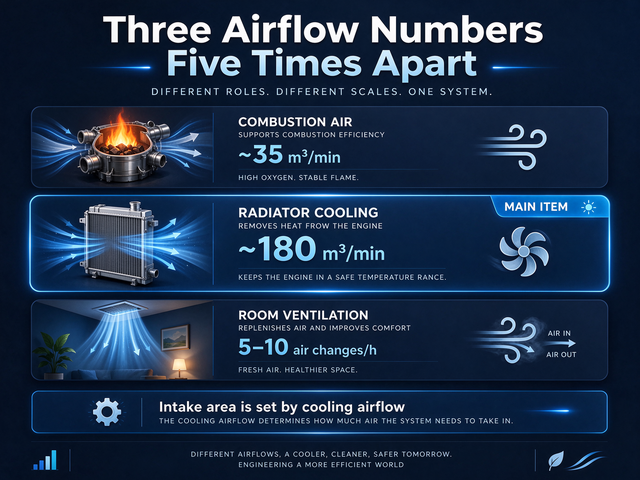
A generator room feeds three demands: combustion, radiator cooling and ventilation. They differ by an order of magnitude, and a single per-kW factor drops the largest one.
Combustion air comes first: diesel burns near 14.5 to 1, about 0.07 m³/min per kW, so 500 kW needs roughly 35 m³/min.
Radiator cooling air is set by the fan and read from the datasheet: 500 kW class sets commonly sit at 150–250 m³/min. At 180 m³/min it is five times combustion air, and it sizes the opening.
Room ventilation comes third, normally allowed at 5 to 10 air changes per hour to clear heat from the exhaust pipe, silencer and switchgear.
Conclusion: the intake is set by cooling airflow. Sizing it from combustion air alone means cutting an opening one-fifth of the size required.
2. From airflow to opening area
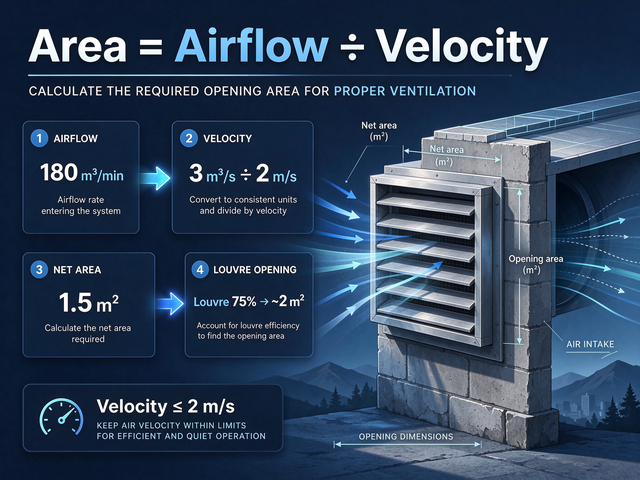
Net area equals airflow divided by velocity, with intake velocity held at or below 2 m/s, the shared limit for noise, rain ingress and filter pressure drop.
180 m³/min is 3 m³/s; divided by 2 m/s it gives 1.5 m² net. Weather louvres deliver only 70 to 80 per cent of their outline as free area, so the opening comes out at about 2 m².
The discharge should be at least 1.1 times the intake area: expanding hot air, slight positive pressure and duct bends all take a bite. Door gaps and cable trenches cannot count as intake.
Conclusion: tender the net area and build the outline area, and put both numbers on the drawing.
3. Three details that go wrong
First, external static pressure: datasheets usually allow about 0.1 kPa. Add a silencer, three bends and a twelve-metre duct and resistance is well past it; the fan turns but airflow falls 30–40 per cent. Every 90-degree bend counts at its equivalent length.
Second, hot air recirculation. A discharge too close to the intake, or blown into a light well, brings the hot air back. Intake temperature moves from 35 to 45°C, the set derates on the correction table, and a bigger opening no longer helps: the airflow path has to be fixed first.
Third, the temperature basis. Output is quoted at 40°C or 25°C ambient, losing 1 to 2 per cent per degree above it. Keep the room within 10°C of ambient and the battery room near 25°C.
Conclusion: airflow, static pressure and temperature are one account; change one and the problem moves to the duct.
Frequently asked questions (maintenance and selection)
Q: At 1,900 m altitude in Yunnan, should a 500 kW room enlarge its intake beyond the lowland figure?
Yes. Air density at 1,900 m is about 80 per cent of the sea-level value, so add roughly 20 to 25 per cent to the net area. The set is also derated about 4 to 5 per cent per 1,000 m. Both corrections belong in the same calculation.
Q: If intake air passes 40°C in summer, can the set still deliver rated power?
Not at the nameplate figure. Above the 40°C basis the derate runs at 1 to 2 per cent per degree, so a 500 kW set is near 450 kW at 45°C. Fix the air first.
Q: For a 500 kW soundproof canopy indoors, size the intake on canopy or room airflow?
On canopy airflow from the datasheet; the room only supplements it, so do not double-count. Leave at least one metre to the wall and never discharge at another set's intake.
Q: Two 500 kW sets in parallel in one room, does the intake simply double?
Sized on combined airflow at the same velocity, it comes out slightly above twice the single-set area. Keep 1.5 m between sets, and calculate the discharge separately.
What this means for buyers and operators
Buyers should put all three figures into the specification at drawing stage: combustion air at 0.07 m³/min per kW, cooling air at the datasheet value, and the intake stated as net area with the louvre ratio noted. Operators should measure once before summer: intake temperature, discharge velocity, and water temperature plus output at full load.
If the air cannot get in, even a good set runs at reduced output.
What intake temperature does your plant room see in summer, and have you ever had to derate because the room could not breathe?
Categories
News
Contact Us
Contact: yuchai Generator Set
Phone: +86 13312561188
Tel: +86-0871-67352758
E-mail: postmaster@zimbon.com
Add: 11th Floor, Office Building C, Shuangcheng Intercity Business Center, No. 8868 Guangfu Road, Guandu District, Kunming City, Yunnan Province, China