Industry news
Virginia Tightens Emissions Rules for Backup Generators
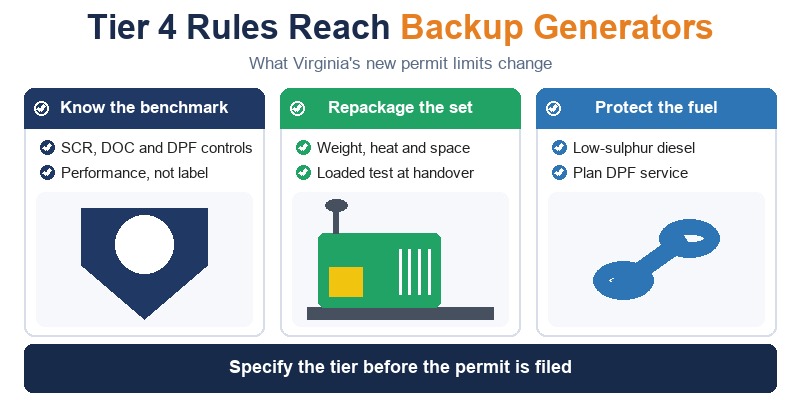
Data center operators in Virginia now face a stricter bar for backup power. Legislation adopted earlier this year, together with implementing regulations that took effect on 4 November 2026, requires new data center air permits in the state to limit engine-generator set emissions to the level achieved by a Tier 4-equivalent unit. The change reshapes how standby diesel packages are specified, priced and maintained — and it is a signal other fast-growing data center markets are likely to study.
What the rule actually requires
House Bill 507, codified at Virginia Code Section 10.1-1322.6(B), bars the Virginia Department of Environmental Quality from issuing an air permit — including coverage under a general permit — for any data center application submitted on or after 1 July 2026 unless each engine-generator set is permitted at or below Tier 4-equivalent emissions. The state air board's implementing regulations, published in the Virginia Register on 5 October 2026, mirror that requirement. A Tier 4-equivalent set is defined by three families of aftertreatment: selective catalytic reduction to cut nitrogen oxides, a diesel oxidation catalyst for carbon monoxide and hydrocarbons, and a diesel particulate filter for particulate matter. Importantly, the standard is performance-based rather than certification-based. A generator does not need a particular label if equivalent controls reach comparable results — but the applicant carries the burden of demonstrating that equivalence in the permit file.
Why one state's rule matters elsewhere
Northern Virginia holds one of the densest concentrations of data center capacity in the world, so its permitting practice is watched closely across the industry. The rule also lands at a moment when standby fleets are growing larger: AI-driven halls draw far more power per rack, pushing backup plants into the multi-megawatt range and turning emissions compliance from a footnote into a design driver. Buyers in other markets should read the trend, not the statute. More tenders now name an emissions tier outright, and a supplier that cannot produce an engine type-approval certificate matching the nameplate rating is a schedule risk, not a saving.
What changes on the equipment side
Aftertreatment adds length, weight and heat rejection to a generating set. SCR needs a diesel exhaust fluid tank, dosing control and sufficient exhaust temperature to function; a DPF needs regeneration, which is precisely what lightly loaded standby engines struggle to deliver. Packages therefore have to be engineered as a whole — base frame, canopy volume, ventilation and controls — rather than assembled from a standard set with a filter bolted on. Fuel quality matters as well: high-sulphur diesel accelerates ash loading in a particulate filter, so sites in markets without clean fuel should either secure a low-sulphur supply or choose a configuration that does not depend on a filter. Commissioning should include a loaded test that verifies both electrical output and aftertreatment performance, backed by a maintenance plan covering reagent quality, filter servicing and sensor calibration.
The outlook
The direction of regulation is consistent wherever grids are strained and air quality is scrutinised: lower NOx and particulate limits, with performance demonstrated rather than assumed. For buyers, that argues for naming the emissions standard in the enquiry, asking for certificates before the order is signed, and sizing the enclosure around the aftertreatment from day one. ZIMBON builds generator sets from 5 kW to 2500 kW with Yuchai, Cummins, Mitsubishi and Volvo power, and configures packages to the emissions tier and fuel quality of the destination market — a conversation worth having at the specification stage rather than after the permit is filed.
Categories
News
Contact Us
Contact: yuchai Generator Set
Phone: +86 13312561188
Tel: +86-0871-67352758
E-mail: postmaster@zimbon.com
Add: 11th Floor, Office Building C, Shuangcheng Intercity Business Center, No. 8868 Guangfu Road, Guandu District, Kunming City, Yunnan Province, China