Industry news
AI Data Centers Push Genset Demand Toward $25 Billion
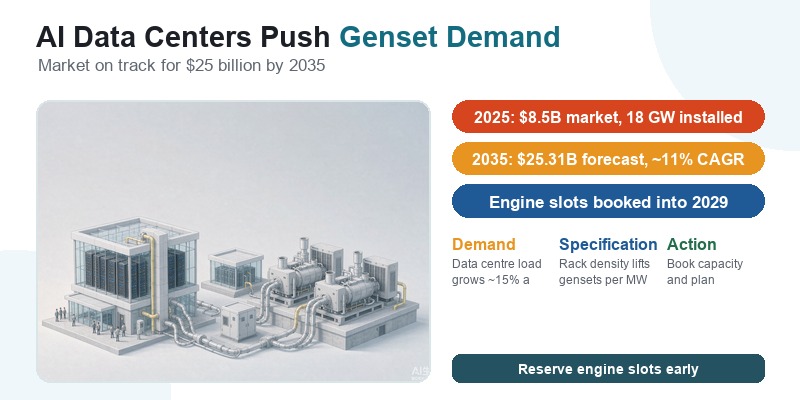
The standby generator business has quietly become one of the fastest-growing corners of the power equipment industry. According to a new market analysis by Global Market Insights, the data center generator market was valued at USD 8.5 billion in 2025 and is expected to reach USD 9.91 billion in 2026, before climbing to USD 25.31 billion by 2035 — a compound annual growth rate of about 11.5 percent. The force behind the curve is artificial intelligence.
A market compounding at double digits
Global Market Insights estimates that data centers already supported 18 GW of installed standby generation capacity in 2025, with North America the largest market and Asia Pacific the fastest growing. Caterpillar held more than 19 percent of the market, and the top five manufacturers — Caterpillar, Cummins, Rolls-Royce Power Systems, Kohler and Generac — together accounted for roughly 60 percent of sales. The demand side is equally striking. The International Energy Agency estimates that data center electricity consumption will grow about 15 percent per year between 2024 and 2030, more than four times faster than every other sector combined, while property consultant JLL calculates that around 10 GW of new data center capacity broke ground globally in 2025 and that the installed base will roughly double from 103 GW to 200 GW by 2030.
AI workloads rewrite the specification
Tier III and Tier IV certification rules anchor much of this growth. Both topologies require redundant, parallel generator architecture regardless of how reliable the local grid is, which fixes a minimum genset count for every facility that is commissioned. AI workloads push that count higher still: as rack density rises, each megawatt of IT load now carries more standby generation than it did in the cloud-era builds of two or three years ago. Orders reflect the shift. Caterpillar received a 2 GW generator order for a single hyperscale AI campus in 2026, and on its third-quarter earnings call the company said orders for large reciprocating engines are now booked into 2029, with a record backlog of about USD 78 billion — nearly double the level of a year earlier. At the China International Import Expo in Shanghai this month, the company also premiered the FG Wilson PE2500-2, a 2,000 kW genset built specifically for data centers, with HVO fuel compatibility and ratings for 50°C ambient temperatures and 1,500 m altitude.
What buyers should take from it
For organizations planning standby power in this market, three lessons stand out. First, procurement timing now matters as much as technical specification: with large-engine production slots reserved years ahead, projects that leave gensets to the final design stage risk missing their energization dates. Second, redundancy should be planned at the architecture level — paralleling several mid-size sets, commonly in the 1,500 to 2,000 kW class, often delivers better availability and service flexibility than a single very large unit. Third, fuel flexibility is becoming a specification requirement rather than an option, with HVO-compatible engines increasingly requested to hedge future emissions rules.
The outlook is for demand to stay strong well into the next decade. For buyers in the 5 kW to 2,500 kW range — industrial sites, commercial buildings and mid-size facilities — the same dynamics apply in miniature: order early, size for redundancy, and specify engines that can run on emerging low-carbon fuels. Manufacturers with shorter delivery cycles and established service networks, including genset builders across Asia, are well positioned to capture projects that the largest OEMs can no longer serve within a typical project window.
Categories
News
Contact Us
Contact: yuchai Generator Set
Phone: +86 13312561188
Tel: +86-0871-67352758
E-mail: postmaster@zimbon.com
Add: 11th Floor, Office Building C, Shuangcheng Intercity Business Center, No. 8868 Guangfu Road, Guandu District, Kunming City, Yunnan Province, China