Product FAQ
Can a Diesel Generator Run on HVO Renewable Diesel?
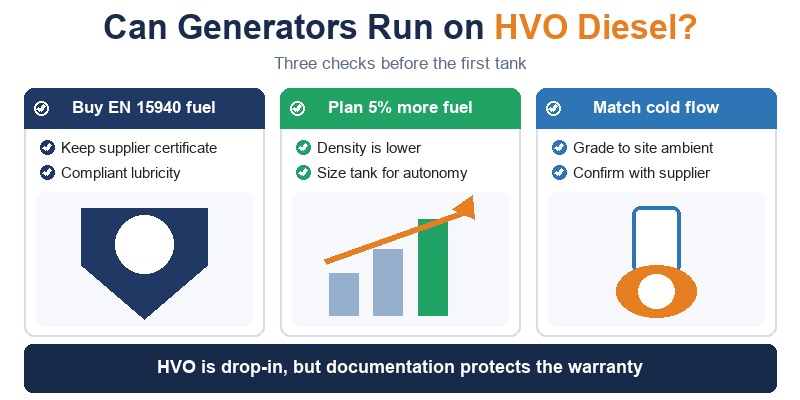
Hydrotreated vegetable oil (HVO), also sold as renewable diesel, has moved from a sustainability pilot to a routine fuel option for standby generating sets. Data centre campuses in Sweden, Wales and Norway already run it, and on 29 October 2026 Sabey Data Centers began testing HVO as the primary fuel in backup generators at its Austin, Texas campus. For buyers, the practical question is no longer whether HVO works, but what has to be checked before the first tank arrives.
It is a drop-in fuel, not a biodiesel blend
HVO is produced by treating vegetable oils and waste fats, including used cooking oil, with hydrogen at high temperature. The result is a paraffinic hydrocarbon chemically close to fossil diesel, with almost no aromatics or sulphur. That is why it runs in an existing generator without engine modification, unlike FAME biodiesel, which carries oxygen in its molecules, ages faster in storage and can soften older elastomer seals. Neat HVO and any blend with EN 590 diesel are generally accepted. A 2022 peer-reviewed study by the US Department of Energy Argonne National Laboratory found that renewable diesel from waste-based feedstocks cuts lifecycle greenhouse gas emissions by 79% to 86% against petroleum diesel, while crop-based feedstocks deliver 40% to 69%.
Expect a small fuel penalty, not a derate
HVO is slightly less dense than diesel, so more litres are burned for the same energy. Cummins advises planning up to 5% higher consumption by volume and notes a possible 1% to 2% mechanical power loss, which at most ratings stays inside the published margin, so no derate is required. Perkins ran a 1,000-hour test that measured 2% to 2.5% higher consumption on average, with a 3.7% maximum, no change to service intervals and no meaningful difference in noise or vibration; ISO 8528 load acceptance was met. A site with a tight autonomy requirement should size its tank on the larger allowance.
Three checks that protect the warranty
Fuel specification comes first. Buy only HVO certified to EN 15940, or renewable diesel meeting ASTM D975 in the United States, and keep the supplier certificate with the service records. HVO has lower natural lubricity than diesel; compliant fuel carries lubricity additives, but off-specification product can seize a fuel pump or injector. Cold flow is second: low-temperature performance is formulated into the fuel, so match the grade to the coldest ambient the site will see and confirm it with the supplier, because anti-gel additives written for diesel may not behave the same way in a paraffinic fuel. Storage is third, and here HVO is easier than biodiesel. It resists oxidation and microbial growth and forms less sediment than ultra-low-sulphur diesel over long idle periods, although water and dirt remain the same risk, so polishing and testing schedules stay unchanged. At the tailpipe, NOx is comparable to diesel and particulate matter is lower, which matters where permits are written around fuel consumption.
For a standby set that may run twenty hours a year, HVO is one of the few decarbonisation routes that does not change the machine, and the remaining work is documentation: fuel certificate, consumption baseline and a service record showing what went into the tank. ZIMBON builds diesel generator sets from 5 kW to 2,500 kW on Yuchai, Cummins, Mitsubishi and Volvo platforms, and specifies fuel system and tank options for operators planning a renewable fuel switch. Naming the fuel at specification stage is always cheaper than retrofitting it afterwards.
Categories
News
Contact Us
Contact: yuchai Generator Set
Phone: +86 13312561188
Tel: +86-0871-67352758
E-mail: postmaster@zimbon.com
Add: 11th Floor, Office Building C, Shuangcheng Intercity Business Center, No. 8868 Guangfu Road, Guandu District, Kunming City, Yunnan Province, China