Industry news
Space-Scarce Data Centers Rethink Backup Power
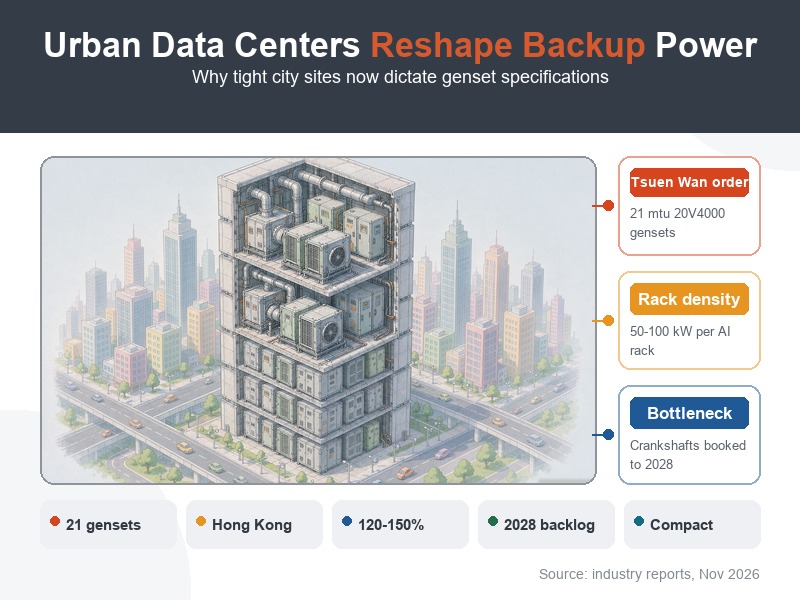
When Rolls-Royce Power Systems signed an order to supply 21 mtu 20V4000 DS4000 diesel generator sets to Goodman for a data center in Hong Kong's Tsuen Wan district, the engineering brief was as much about floor area as about megawatts. On a dense urban site, the operator needed to protect as many server racks as possible within a limited footprint, and chose a low-voltage distribution architecture to shrink the fault domain of each power train. The project is a useful snapshot of how land constraints are beginning to shape data center backup power specifications.
Density is driving the specification
AI training and inference have pushed rack power density to roughly 50-100 kW, five to ten times the 10-20 kW typical of conventional server rooms, and total site load is moving from hundreds of megawatts toward gigawatt scale. Research from Kaiyuan Securities estimates that genset configuration ratios have climbed from 80-100% under traditional N+1 or 2N architectures to 120-150% in advanced AI data centers, turning standby capacity from an optional extra into a rigid requirement. Because a UPS bridges only ten to fifteen minutes, the diesel generator set remains the final line of defense: data center units are expected to start, accept load and stabilise within 10-15 seconds, versus about one minute for a standard industrial set. For buyers, that combination of more kilowatts, less floor space and faster starting points toward compact, high-output units with carefully planned ventilation, exhaust routing, fuel storage and paralleling controls.
Why a tower changes the power train
Vertical, space-scarce buildings also change how power is distributed. In the Tsuen Wan project, the supplier highlighted a low-voltage architecture that reduces the fault domain of each generator block and improves resilience: a fault affects a smaller portion of the load. Rolls-Royce Power Systems has said that roughly 25% of the world's data centers rely on the mtu 4000 series for emergency power, with its order book now covering 2028 and some long-term agreements extending to 2030. The wider supply picture is similarly stretched. China's customs data show exports of compression-ignition generating sets above 2 MVA reached 4,547 units in the first nine months of 2026, already ahead of the 3,339 units shipped in the whole of 2025, while the China Internal Combustion Engine Industry Association expects domestic data center genset demand to exceed 6,000 units in 2026.
Capacity is expanding, but slowly
Manufacturers are responding on two fronts. Rolls-Royce has outlined a plan to double its power generation capacity by 2028, with US plant expansion only coming on line in phases from early 2026; Caterpillar has set a large reciprocating generator capacity target around 2030. Industry genset lead times of 8-12 months can stretch to around 18 months for the most sought-after high-horsepower models, and some overseas quoted prices have risen by about 20%. The tighter bottleneck sits upstream: crankshafts, large-bore cylinder liners and high-pressure fuel injection systems require long qualification cycles and dedicated tooling, so one component supplier in Guilin has moved to zero-buffer delivery with crankshaft orders booked into 2028. Analysts describe the result as a structural shortage of shafts and liners rather than of complete engines. On the product side, Weichai has launched a full range of medium-speed land power station engines covering 1,200-8,640 kWe with multi-fuel capability, reflecting demand for flexible high-output platforms.
What specifiers should take away
The direction is clear: backup power is being designed into a project earlier, alongside site selection and electrical architecture, rather than being fitted into leftover yard space. Vendors able to offer high power density in a compact footprint, documented 10-15 second load acceptance and proven paralleling logic will be better placed as urban AI capacity grows. ZIMBON (Yunnan Zhenbang Mechanical & Electrical Equipment Co., Ltd.) supplies diesel generator sets from 5 kW to 2,500 kW with Yuchai, Cummins, Mitsubishi and Volvo power, and works with data center and industrial buyers on footprint-constrained layouts, starting performance and redundancy planning. For operators, the practical advice is to reserve physical space and place long-lead orders early, then validate the entire power train, from engine and alternator through ATS, fuel system and load bank testing, against actual rack density rather than a generic nameplate figure.
Categories
News
Contact Us
Contact: yuchai Generator Set
Phone: +86 13312561188
Tel: +86-0871-67352758
E-mail: postmaster@zimbon.com
Add: 11th Floor, Office Building C, Shuangcheng Intercity Business Center, No. 8868 Guangfu Road, Guandu District, Kunming City, Yunnan Province, China