Industry news
Predictive Maintenance Reshapes Genset Service Models
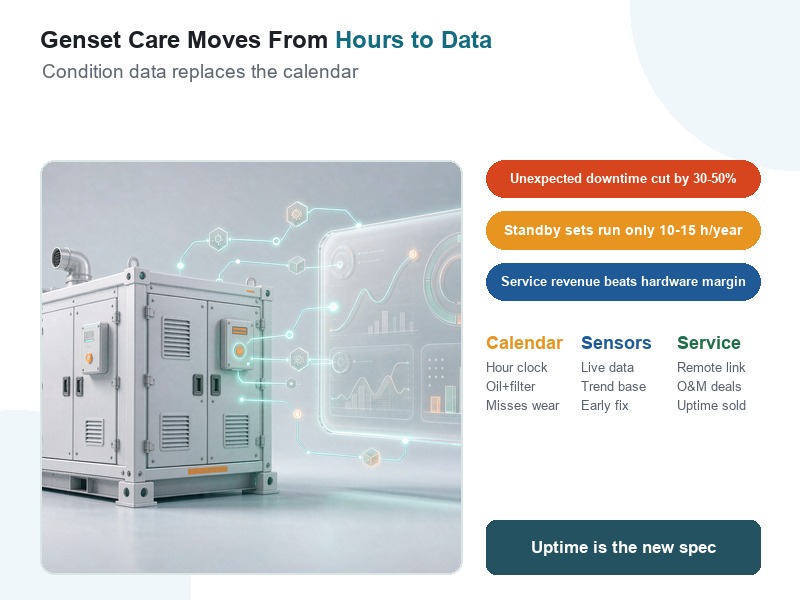
For most of their lives, standby diesel generators do exactly nothing. A hospital set may run fewer than fifteen hours a year, yet it must start and carry full load within seconds when the grid fails. A growing body of industry research argues that this reliability is won through data, not just through hardware quality.
From calendar checks to condition data
Traditional service follows fixed calendar or running-hour intervals: oil and filter changes, coolant checks, battery tests. Those routines still matter, but two engines with the same hours can be in very different condition depending on load, ambient heat, dust and fuel quality. Modern controllers already log the parameters that reveal this difference: operating hours, load profile, coolant temperature, oil pressure, battery status, fuel level and fault codes.
A 2026 industry report on the genset sector estimates that connecting sets to industrial-internet platforms for predictive maintenance can cut unexpected downtime by 30-50%, and that AI-based energy scheduling in hybrid systems can trim diesel consumption by 10-15%. Standards reinforce the shift: NFPA 110 requires monthly loaded exercises and a four-hour test every 36 months for Level 1 systems, precisely because low running hours hide deterioration. Oil still oxidizes and fuel still picks up water while the engine sits idle.
What monitoring can and cannot do
Telematics vendors are careful about scope. Effective programs select a limited set of readings that matter for each asset class, establish a normal baseline and define who responds when a value drifts out of range. A dashboard full of unreviewed alerts can bury the critical warning rather than prevent the failure.
Remote status also does not replace hands-on inspection. Fuel contamination, hose degradation and some mechanical faults develop where only a site check will find them. Oil analysis, thermal imaging and vibration testing remain complementary tools, most valuable when results are trended against a documented history. Buyers of large installations are also adding a security dimension: connected controllers create a network path to equipment that can start, stop or disable a genset, so specifications increasingly reference IEC 62443 controls, network segmentation and signed firmware updates.
From selling hardware to selling uptime
The commercial effect is visible in market structure. The same 2026 report describes a shift from one-time equipment sales toward rental, O&M contracts, energy trusteeship and customized microgrid services, with service margins exceeding hardware sales. Data centers are the main driver, contributing more than 60% of incremental demand, while China's domestic genset market is forecast to reach RMB 13.4 billion in 2026, up 4.3%, with high-power units growing 8-10% and the low-power segment contracting.
Regulation adds nuance. In the United States, certified emergency sets can skip Tier 4 Final aftertreatment if non-emergency operation stays within 100 hours a year, but routine peak shaving or demand response can trigger stricter standards, another reason operators want accurate running data.
For buyers, the practical conclusion is to write monitoring into the specification rather than treat it as an accessory: define the parameter set, alarm escalation, fuel-quality testing and cybersecurity requirements, and match the set to a realistic duty profile. Manufacturers such as ZIMBON Power (Yunnan Zhenbang), which supplies gensets from 5 kW to 2500 kW with remote monitoring and local service support, reflect an industry-wide move to sell guaranteed availability rather than kilowatts alone.
Categories
News
Contact Us
Contact: yuchai Generator Set
Phone: +86 13312561188
Tel: +86-0871-67352758
E-mail: postmaster@zimbon.com
Add: 11th Floor, Office Building C, Shuangcheng Intercity Business Center, No. 8868 Guangfu Road, Guandu District, Kunming City, Yunnan Province, China