Product FAQ
Freeze at −5 °C: What to Pre-Heat Before a Genset Cranks?
Southern Power Grid expects the strongest low-temperature icing spell in the southern region in nearly a decade this winter, and utilities have already tested de-icing equipment ahead of time. For sites in Yunnan's Zhaotong, Qujing and Diqing, where winter mornings drop below zero, the real test for a standby genset is not a summer load run but the first cold crank of the season — many units are woken only on the coldest days of the year.
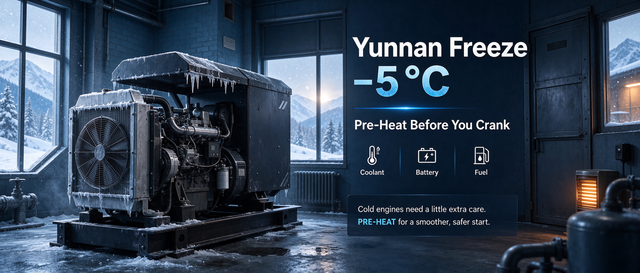
1. Pre-heat the coolant, not the ignition key
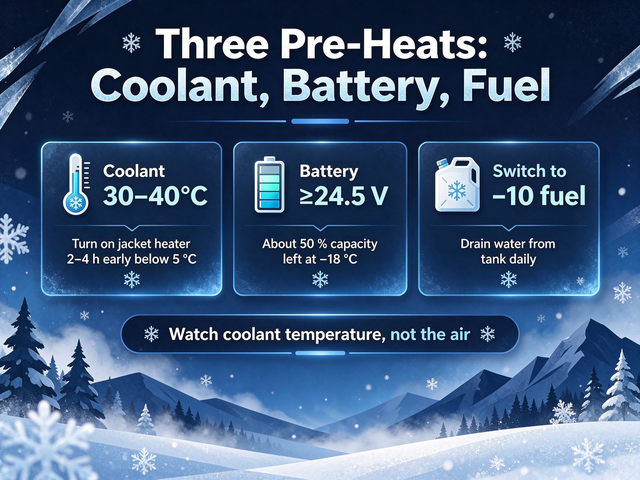
Most cold-start failures are not mechanical: below 5 °C the compression end temperature is too low, diesel atomises poorly and cannot sustain combustion, and harder cranking only drains the battery and heats the starter. With a jacket-water heater, switch it on 2–4 hours ahead when ambient is below 5 °C and bring coolant to 30–40 °C; without one, warm the block and oil sump above 0 °C with hot air or an insulated blanket.
Conclusion: judge by coolant temperature, not by the air temperature on the wall. Set the coolant freeze point for the local extreme: below −10 °C, raise glycol to roughly 50 % so the mixture holds about −35 °C. Testing the freeze point before the cold snap costs far less than repairing a cracked block afterwards.
2. The battery is the first casualty of a freeze
Lead-acid usable capacity halves by −18 °C while cranking current rises, so the battery usually sags first: the starter turns slowly, white smoke appears without firing, and people blame the fuel system.
Conclusion: during the freeze season, measure the resting voltage weekly; on a 24 V system, recharge anything below 24.5 V. If voltage drops below 18 V while cranking, replace the battery instead of cranking again. For long-term standby units, top up the charge every three months, fit a battery thermal jacket on outdoor or semi-outdoor skids, or move the battery to the warmer inner side of the room.
3. Change the fuel grade, drain the water
Summer-grade (0) diesel has a cloud point near 0 °C and a higher cold filter plugging point; at −5 °C it waxes, the filter plugs and the engine cranks without catching. Switch to grade −10 and run most old fuel out of tank and lines rather than mixing grades.
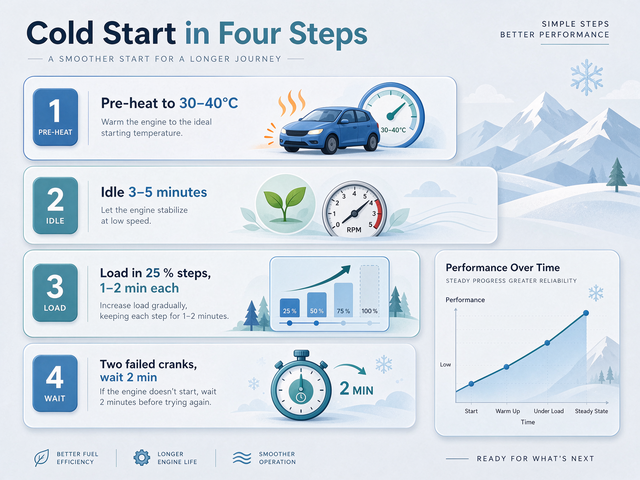
Conclusion: drain a little water from the tank bottom valve every day before start until clean diesel appears, and drain the water separator weekly. After a successful start, idle for 3–5 minutes until oil and coolant temperature rise, then load in 25 % steps with 1–2 minutes between steps. After two failed cranks, wait 2 minutes; if the third attempt still does not fire, stop cranking and check fuel flow and air intake.
FAQ (maintenance and selection)
Q: For a 500 kW standby genset at −5 °C in Zhaotong, Yunnan, how early should the jacket heater be switched on?
A: Two to four hours ahead, coolant to 30–40 °C. For units idle all winter, keep the 1–2 kW heater on thermostatic standby; cheaper than a failed cold start.
Q: After two failed cold cranks, can we try a third time immediately?
A: No. Wait 2 minutes and check battery cranking voltage, whether the water separator has waxed up, and whether ice or snow blocks the air intake. Never crank longer than 10 seconds at a time, and leave at least 30 seconds between attempts, or the starter will overheat.
Q: At a construction site in Qujing at −8 °C, which starting method suits a 500 kW unit?
A: Electric start with a jacket-water heater plus battery thermal protection is the baseline; where ambient is lower or 10-second load acceptance is required, add air starting or a dual starting system. Write both the minimum starting temperature and the starting time into the technical agreement.
Q: When buying for a freezing region, should cold-climate options be a separate contract line?
A: Yes. List heater power, battery warming or heating device, and a cold-start test at the local minimum temperature as three separate clauses, and witness one −5 °C cold start at acceptance rather than trusting datasheet figures.
For buyers and operators: freeze-season reliability is prepared before winter, not purchased with the unit. Make coolant freeze point, battery voltage and fuel grade a three-line winter checklist on the plant room door and fill it in weekly.
Has your standby genset had a single −5 °C cold-start test this winter?
Categories
News
Contact Us
Contact: yuchai Generator Set
Phone: +86 13312561188
Tel: +86-0871-67352758
E-mail: postmaster@zimbon.com
Add: 11th Floor, Office Building C, Shuangcheng Intercity Business Center, No. 8868 Guangfu Road, Guandu District, Kunming City, Yunnan Province, China